OVERVIEW
By L.H.Barker
The Bladensburg painting links below
open a new window and are as follows:
Magruder
Dining Room (Politics and Port)
Magruder Dining Room (Politics and Port) full size/detail
Market
Master's House (Open for Business)
Market Master's House (Open for Business) full size/detail
Battle
of Bladensburg/War of 1812 (The Parole of an American Hero)
Battle of Bladensburg/War of 1812 (The Parole of an American Hero) full size/detail
The 3 paintings represent 17 months of
work & lot of research for the team, so I hope you enjoy & find them
educational.
Bladensburg is located in Prince George's county, MD and is approximately
ten miles east of Washington DC.
___________________________________________________________________________________________
The methodology:
Anatomy of a Painting/Illustration
Phase I: discuss the project scope, the time frame, budget, what needs to be covered, the audience, the goal of the piece, i.e. what are we trying to convey, to whom &, whose point of view or reference - determine what needs to be collected: research, maps, site reference photos, site plans, mediums that will be used for the actual painting
Phase II: establish the overall theme, begin adding details-generally work from the most important elements to minor ones -refine approach -for the characters, work out the actual poses, gestures & expressions; try to psyche out the characters minds, shoot mannequins/references as needed -work out composition issues
Phase III: prepare and scale the rough for transfer to the final artwork surface. This may involve printing out the rough at the final size and manually transferring it to illustration board with transfer paper or setting up a new digital master file that will evolve into the final master large format file. Gather & print, as necessary, reference materials that will be used during the final painting
Phase IV: begin the final process of painting the final artwork either manually or digitally
Phase V: document the artwork (photos, scans etc.), prepare image to be shipped or transferred, prepare shipping container
Phase VI: client
follow-up, project promotion, website update
___________________________________________________________________________________________
Project Backgrounds
The scrollable columns below are in chronological order & contain a lot
of material.
Each of the 3 historical illustrations took many
unexpected twists and turns while in progress. It always surprises people
to learn that working out the composition can take 50% or more of the paintings
total work time because of all the detail and accuracy required. You will
learn below why goauche is such a great medium for these projects due to the
time restraints (oils would take too long to dry) and the sometimes unavoidable
revisions in the paint stage.


AN
ARTIST'S VIEWPOINT |
| The Market Master's House,
1777 ("Open for Business") |
May 12, 2010 The design & composition begin. The Market Master's House is situated on the edge of an industrial area in historic Bladensburg, Maryland adjacent to Annapolis Road and Kenilworth Avenue. The building, associated with the earliest period of the town's devel- development, serves as an important surviving example of eighteenth-century vernacular architecture (King 1989:3). Constructed about 1765 by Christopher Lowndes, the small, one and a half story gable-roof structure lay adjacent to the town's Market Square on a long, narrow lot that fronts present day 38th Street. Client's initial description: The
building was built around 1760 by Christopher Lowndes. We believe he
used it as a store and/or dwelling at that time. By around 1775 it is
a post office and store. Someone may have also lived on the premises.
It is no longer used as a post office in 1808, but continues to serve
as a store until the 1830s/1840s. Client character descriptions: Town Crier: (I am checking with Nancy Pope at the Smithsonian Postal History museum to make sure a town crier would have been waiting around for the mail. If not, we can stick someone else in the scene). The TC will be dressed in traditional garb with a bell in his hand sitting on the bench next to the old man. Formerly in conversation with the old man, the TC now turns his attention to the carriage driver carrying mail. Horses: There should be four horses pulling the carriage (see photos). Horse colors can be of colors that compliment the piece. Carriage Driver: He just jumped down from his carriage and is carrying a leather satchel filled with letters and a basket of rolled newspaper. He is walking towards Christopher Lowndes who is the Bladensburg postmaster. Christopher Lowndes: He is 64 years old and is distracted by the copious amounts of hemp cord that he needs to supply the government for the war effort. He is down at the store to receive news about rope orders. He gets a letter from the Council of Maryland each month. In the meantime, he also operates a small store from this location and has just finished providing goods to a woman and her children. Christopher is in conversation with the woman, but is distracted with the arrival of the mail. Woman: A
woman just purchased goods from Christopher Lowndes, perhaps some cloth.
I would like to make her a servant who is taking care of a few children.
The children can be distracted by a cat that may be perched up high
on the coil of rope. The children include a 5 year old girl and a 2
year old boy. The boy can be crouched down playing with a stick or looking
at a bug on a black-eyed susan, for example. The girl maybe has a handful
of black-eyed susans she just picked from the side of the store. |
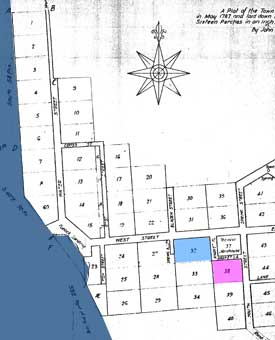 Part of the copied (1897) 1787 plat for Bladensburg's original lots. Market
Master's house (Christopher Lowndes) is highlighted in pink; the Magruder
House is in light blue. The Anacostia River and public landing/port are
in darker blue. Part of the copied (1897) 1787 plat for Bladensburg's original lots. Market
Master's house (Christopher Lowndes) is highlighted in pink; the Magruder
House is in light blue. The Anacostia River and public landing/port are
in darker blue.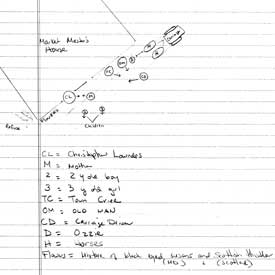 Schematic diagram of the scene from client Schematic diagram of the scene from client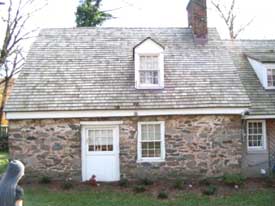 "Front" view of the Market Master's House structure as it is today (private residence). The 18th century living surface was 2 feet lower at the time this painting takes place. The window on the left was originally a door. Courtesy MD State Highway Administration. 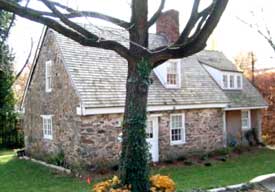 3/4 view same structure; same credits. The client is able to get a few exterior dimensions, but not all that are needed to construct an accurate perspective. 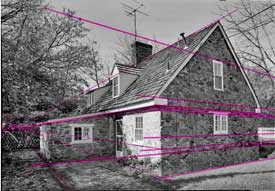 I find the Library of Congress documents for this structure and start to extrapolate from the known dimensions the team was able to get (my pink lines). I also located a floor plan in the documentation of the structure. 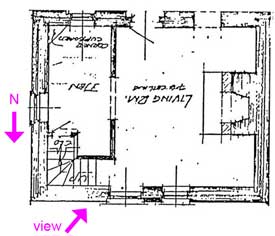 Top two images: courtesy Historic American Buildings Survey (Library of Congress), US National Register of Historic Places ~Setting up the rough perspective~ 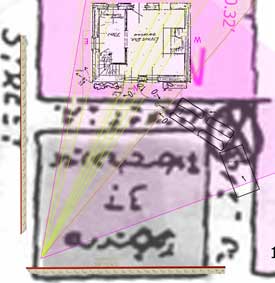 Site plan with 60 degree cone of vision for the suggested view. The gray square in front of the floor plan is what we determine to be the old market square present in 1870. Between the two is what amounts to an alley access to the Market Master's House. Since there is little evidence what specific activities occurred on the square, we pull in closer to the edge of the square and alley. 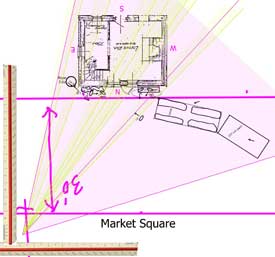 The historic Magruder house is just to our lower right in this site plan. You can see a yellow tack for both in the Google Earth image below. 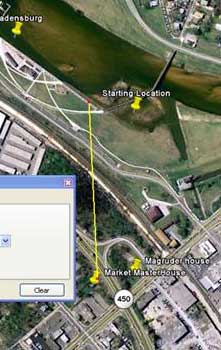 The structure today is surrounded by highways & highway ramps changing the view from 1870. The river cannot be seen today. Google Earth helps me plot how very close (less than a quarter mile) the Anacostia River is to the historic structure-we know it will show and it needs to be addressed in this painting. 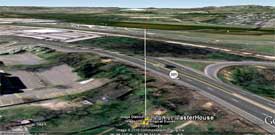 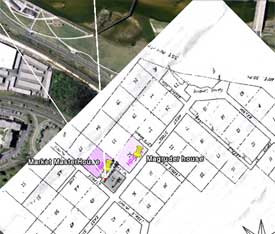 The 1787 plat layer in the current Google Earth view. The bridge and road running to Washington DC (see Battle of Bladensburg) can be seen in the upper right corner. 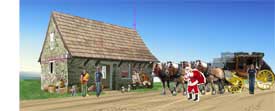 Rollover the image above: The first rough composition is digitally put together fairly quickly using the existing house pictures, 3 SHA team members and yes-a Santa Claus act as scaled place holders until I can find a good example of a man carrying a heavy (mail) sack. Often, team member research is not at the same point, so placeholders are used until further information is available. The rolled over rough shows a developing market square concept in the foreground, a store sign and eave brackets. .jpg) Above: a descendent's portrait of Christopher Lowndes. Courtesy MD State Highway Administration. Since we have no clear visual or written description of the man, I use his descendants facial characteristics. 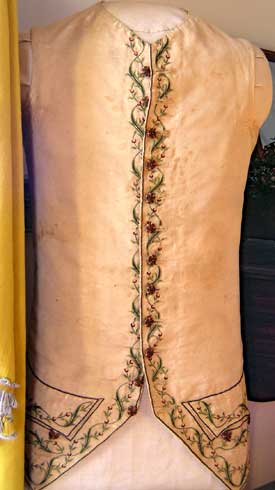 A surviving intricately embroidered 1775 waistcoat belonging to Christopher Lowndes (above, courtesy MD SHA) is meticulously reproduced in the final painting detail. The garment's details display his wealth. 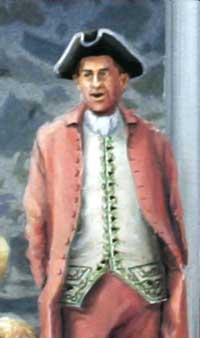 Lowndes' early natural hair is eventually replaced with a period appropriate wig which also is a display of weath and his rough/rugged look is changed to a softer personality late in the paint stage. 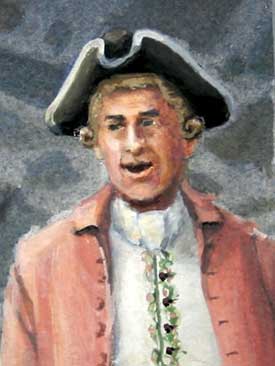 > >Detail. Pink for men was a very fashionable statement at this time! 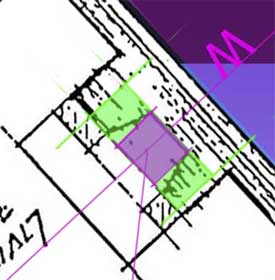 The team members on these historical projects are like detectives, trying to determine what a place was really like back in time. In this case there is some doubt that the existing structure's chimney is original, so we go back in time to try and determine what would have been the original fireplace. Above, overlay the current fireplace foot print with what was believed to be the original footprint. |
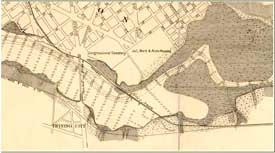 1891 Army Corp of Engineering map of the Anacostia River. This river has changed course, flooded and silted up so many times over two centuries we wanted to go back in time to find out where the actual river banks were in 1870. This is where all those different map layers going back to the late 1700's I placed in Google Earth was helpful. They all will be reexamined for the Battle of Bladensburg scene. Above Courtesy Library of Congress. 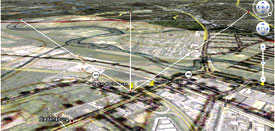 > >A translucent 1903 map over the USGS 2010 Google area of Bladensburg suggests where the river had been (see the winding bluish grey path going to the upper left corner). 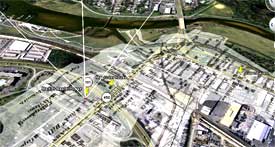 Going back in time, a 1861 Martenet map is transparently laid over the 2010 USGS in Google Earth. Below, the 1787 Martenet map over the 2010 USGS in Google Earth. 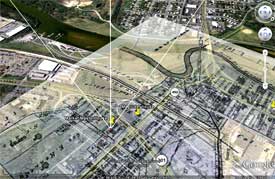 1787 Bladensburg over 2010 maps; there is a substantial river course change again. 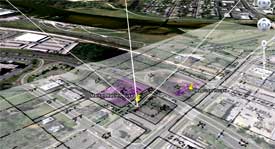 3-D transparent 1787 plat map over 2010 USGS looking for the Port of Bladensburg and the river's boundaries. 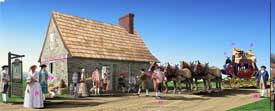 Rollover the image above: a chimney is added, the woman with two small children becomes a nanny, the eave brackets come out and support posts go in, the market square will not be addressed due to lack of factual material and characters begin to get developed & moved around. |
Mid-way through the rough composition process, the SHA team believes they uncovered evidence during an excavation/dig of a drip edge that indicated an overhang structure on the front of the building. The store sign and side windows get taken out, a porch overhang and dormer window get added as do sailing ships once we ave a good understanding where the Anacostia river boundaries probably were at this time. The stage coach gets changed and a shed to the left is roughed in for scale. |
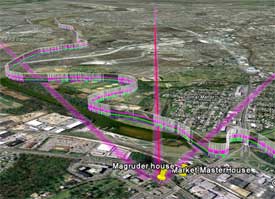 View in Google Earth mapping the closest river path from early maps. The "curtain" depicts grade, 50' (greenline), 100' (pink line) and 200' (top/white line) to give me scale for the ships from our view and location.  The race is on to research the types of ships that could sail this far up the Anacostia River at this point in time. Above, some of the Scottish cargo ships for this period during a Google search. Team member Susan Langley writes: |
| "The types of ships that came to Bladensburg. During the peak period of 18th century shipping, the largest vessels would have been brigantines. There's an issue with nomenclature which I ought to address as I expect you'll run into it. The names used to describe ships aren't always that descriptive since what they describe is the manner in which they are rigged (the size, number and configuration of the sails and ropes), it doesn't always relate to size of the ship or the amount it can carry. Tonnage, when given, is a good guide and there are rough rules of thumb. Another problem is that definitions change. What defines a brigantine in the 18th century changes by the 19th. Shipyard records and designs only start to be kept for military vessels in the 18thcentury so the area of merchant vessels is somewhat nebulous." |
| ~and~ |
| " References
to specific vessels include the snow (see above) Elijah, which was a slave
ship sponsored by C. Lowndes and Benjamin Tasker…however, slave vessels
rarely if ever came to Bladensburg, they went to Benedict where George
Maxwell was a major dealer or to the slave market in Annapolis…this
isn't to say the ship didn't come to Bladensburg at some point, but I
think it's unlikely since snow's are usually quite a bit larger than the
brigantines (>400 tons) so I don't think it could make it up river.
**It appears that at its peak, snows and possibly even ships could indeed make it to Bladensburg. It's unclear if they are using the term "ship" in its official manner which indicates usually 3 masts and considerable size and weight. I question this since the vessel Lowndes built and called The Hawk (1756) was only 130 tons…well within the range of a brigantine. The vessels Trafford and Windsor are each 200 tons and probably are ships and Middleton (no tonnage given) is probably similar since he received letters of marquee for all these in 1757. Also, it doesn't mean that any of them were at Bladensburg; he had interests all over and they could have been moored elsewhere. The "ship" he advertises for sale in 1762 cannot be a true ship at only 56 feet (even though that's keel length) and if it carries 300 hogsheads of tobacco it weight only just over 120 tons. The snow Apollo (1764), is in the Eastern Branch, but not necessarily as high as Bladensburg but interesting as these tend to be larger (225 tons). During the Revolution (1777) there are references to the Governor's council ordering a sloop to obtain cordage from Lowndes but also two ships (Plater and Dolphin) to obtain cordage for the ship Xebeck and the galley Johnson respectively. If these are really ships, they must be smaller ones. Again, many definitions depend on the rigging configuration more than hull but I'm basing these comments on reasonable rules of thumb. There's a reference to vessels capable of carrying 60 tons (100 hogsheads) of tobacco were still loading at Bladensburg in 1835. (In 1807 it could still ship out 1200-1500 hogsheads a year. Brigantine Mary and Jane stopped in St. Mary's for carrying tea in 1774 cargo had been consigned to merchants in Bladensburg and Georgetown. No size/tonnage given. With respect to the Scottish merchants, most were based on the Clyde River around Glasgow but it was common practice to charter English (esp. Whitehaven) or New England vessels as well as using Scottish ones or Chesapeake-built ones in the tobacco trade…so it's not critical to try to find an image of a Scottish vessel. After 1800, the size of vessel is going to drop and you wouldn't be seeing the brigantines, more sloops, ketches and row galleys also called barges. Most of these would be for local transport (not-transoceanic) and possibly for taking goods to vessels in ports with deeper water. There's a reference to "lick-in banks" meaning a small cut into a bank, usually natural often with a spring, where boatmen could stop for a cool drink of water and some shade…on larger sailing vessels this would be unlikely and not necessary so I think it supports rowed, open watercraft..." |
| ******************************************************** The next task is to find the correct type of coach/carriage that would be used as both a mail courier and passenger coach. Beekman or something else? It had to be a long distance vehicle that was substantially built. |
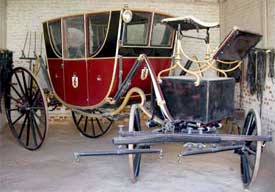 Above: Samuel Powell coach. Image courtesy of Mt. Vernon 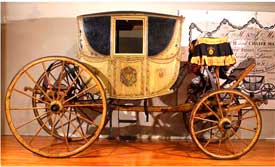 Another Beekman. Above courtesy nyhistory.org 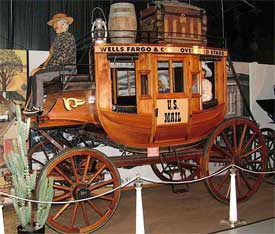 Above-a Wells Fargo Mail coach-we find that this type of coach was only used after the postal system and delivery was more developed. Courtesy Wells Fargo 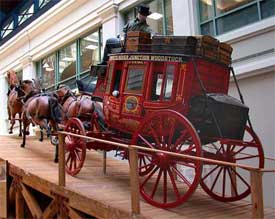 Another variation of a postal coach. Courtesy Postal Museum Smithsonian Institution. 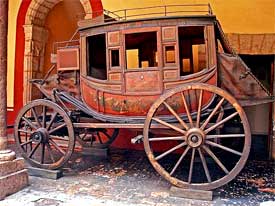 Yet another mailcoach. Courtesy of Wikipedia.com 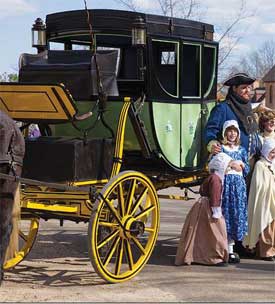 Many coaches later, this is the one we stay with after a number of coach changes on the rough composition. Courtesy history.org 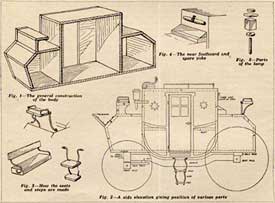 I need to have some rough idea of coach construction and dimensions so I can build the coach to correct scale & perspective in the rough composition. We have to become minor experts on every small detail in each of the historical paintings or they will lose credibility. Courtesy British Postal Museum 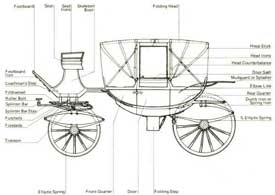 Another coach diagram. This time from the Postal Museum Smithsonian Institution. This is good, because it labels the parts. ******************************************************************* Next is what horse breed and how many pulled the coach? Was there a guard riding on the back? What types of luggage would be carried on these trips? Back to period artwork and much research. 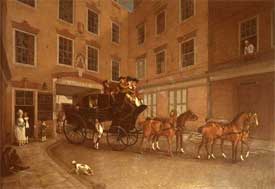 The Departure of the Diligence from Southampton, English School, 19th century, Private Collection, courtesy Bridgeman Art Library International 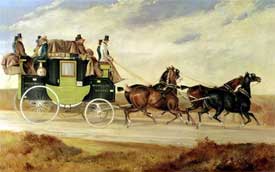 London to Bristol and Bath stage coach, Charles Cooper Henderson (1803-77), Private Collection, Photo © Christie's Images 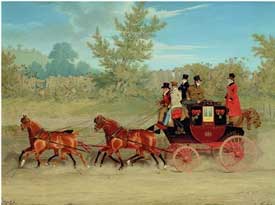 The Exeter Royal Mail on a country road, James Pollard (1792-1867), Private Collection, Bridgeman Art Library International ****************************************************** |
| One of the town crier's responsibilities was to loudly announce the arrival of the mail. This was a social time for the town folks to drop in and pick up mail and/or packages, do a little shopping and visit with each other. What should our town crier look like? What would be appropriate dress? We start to research those aspects & possibilities. |
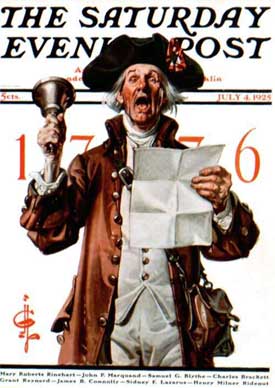 Norman Rockwell's 1925 take of a colonial town crier. Saturday Evening Post. 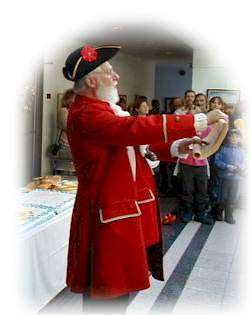 A reenactor playing the Colonial Williamsburg town crier. Courtesy history.org 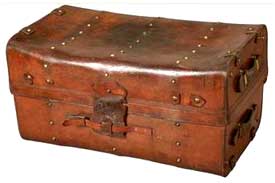 > >Period chests, luggage, valises (leather travel bags like the one seen on the side chair in the Magruder house painting) and their hardware get researched for the luggage rack that was added to the top of the coach. 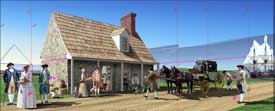 Roll over the image above |
| The coach gets moved back to make room for a team of 4 horses, the left outbuilding gets materials, people get moved around, a wheelwright is added and luggage gets added atop the coach. The pink horizontal line just above the top of the coach is a 100' above grade guideline to properly scale the ship we will use. Final ships to show: the "Providence" and the "Thane" (the taller of the two). |
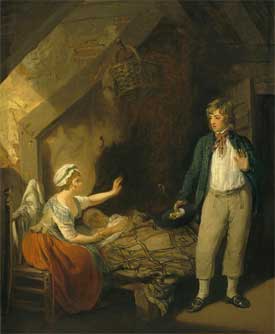 Sailors and a postal carrier get added to the street scene rough; their outfits are researched too. Top:"The Sailor’s Return" (1786), Francis Wheatley. Courtesy National Maritime Museum. Below: Portion of "Village Tavern", John Lewis Krimmel, 1813–14, Courtesy of the Toledo Museum of Art. (There is a postal carrier walking in the door in the painting.) We use this style of 'sack' for our postal carrier/coach driver. 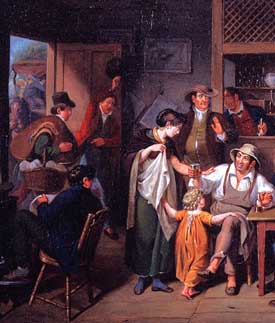 > 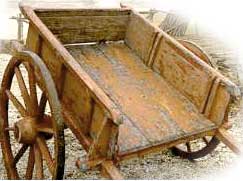 Horse drawn carts and old wagons are researched as a possible prop on the left side of the composition. Plants are also further researched for inclusion. A 1789 death inventory for Christopher Lowndes helps figure out what might be inside the store as well as outside on the grounds. Items like cloaks, bolts of fabric, rope and olive (castele) soap and the more common clay pipes are among this fascinating list. 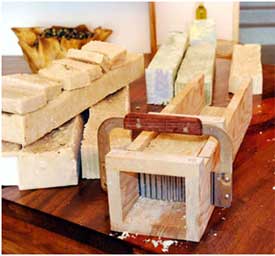 Above: hand made olive (castele) soap bars get cut per order. 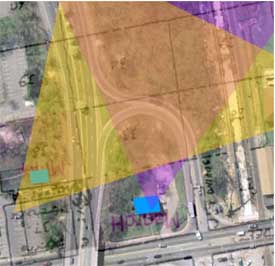 The question comes up whether the "backyard" of the Magruder House will show in this scene & if parts of the Market Master composition will show in the Magruder scene (which is already finished), so I overlay the 1878 plat with the cone of vision for both Market Master's house (yellow) and the Magruder house (pink) paintings over the Google Earth aerial. Young girl's period clothing is researched and this outfit from John Hoppner's "The Little Gardner" seems to be perfect for the feel of this painting. Courtesy Detroit Institute of Arts 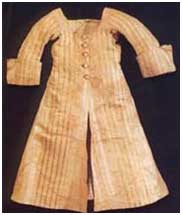 Little boy's period clothing is researched and there are options. Above a toddler's boy's period frock or gown. |
"A philosophical movement toward less restrictive dress for children occurred during the second half of the eighteenth century, and by 1760 the already well-established fashion was for little boys and girls to wear white dresses called frocks that had sashes at the waist. Late in the 1700s, boys began to wear suits with long trousers rather than knee breeches, a fashion that won favor about twenty years before it was accepted by adult men for dress wear. Throughout the century, the time when a little boy went from skirts to pants, which was called, "breeching," occurred anytime from age three to seven and was symbolic of his first step toward becoming a "little man." There is a gray area when a 2 year old switches
from the gown to a "skeleton" suit like below. |
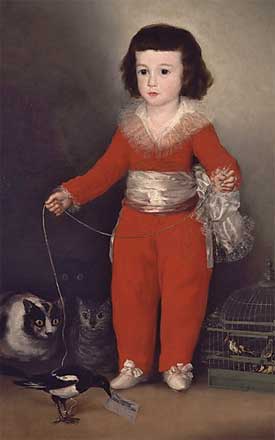 Above portion of "Manuel Osorio Manrique de Zuñiga", Circa 1784. Francisco de Goya y Lucientes (Spanish, 1746-1828). Courtesy the Metropolitan Museum of Art ******************************************************* |
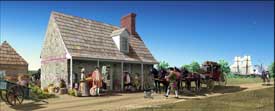 Rollover image above. |
A cart filled with barrels, piles of barrel staves (the wooden slats that form a barrels side), native plants of Scottish thistle and black eyed Susans (the state flower) are added on the left, Lowndes' black mare and a slave are added behind the store, the roof gets aged & some of the characters get moved. The team decides to use team member Julie's son as the model for the
3 year old boy in this and her big gray cat for the 'alpha' cat atop
the rope coils watching for mice. Her Scottish terrier does role playing
once again for this scene. The coach and roof overhang get changed again. |
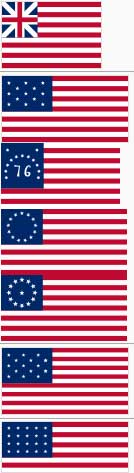 We need to decide which flag design, all current at this time, will fly atop the ships masts. |
~August 9, 2010: finally ready to start painting the final artwork.~ |
| At the end of the rough composition, SHA makes the decision to change the roof shakes to scalloped ones (see image below), as recommended by one of our experts. Also changed are which the ship sails are furled, as experts felt being full sail with the port just out of the compositon was not realistic (the ships would be going too fast to stop). There is a laundry list made up of last changes we don't want to take the time to execute in the rough composition; I need to start the painting process immediately. |
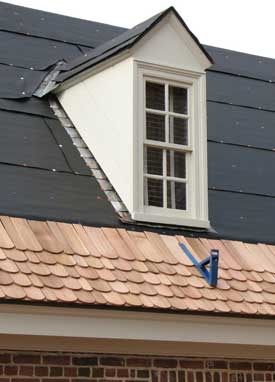 The square off shakes used in the rough are switched to shakes with a radiused bottom (helps prevent warping & cracking as they age) similar to this restoration project at the Paca house. Courtesy Carter Lively, Hammond Harwood House. |
After a lot of work painting the actual stonework that still exists today, there is discussion that there may have been stucco applied over the stone at one point in time. Client goes back over their excavation notes to see if the soil samples contained what might have been stucco. I offer to finish the piece as is and digitally change the stone to stucco so they have both variations without having to repaint the structures walls manually. |
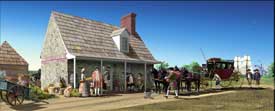 Roll over image: last corrected rough morphs into the first stages of painting. |
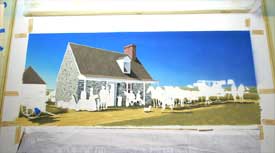 In the shot above, you can see the tape registration marks, the rolled tracing paper line drawing at the top and the printed out color master rough still taped at the bottom edge |
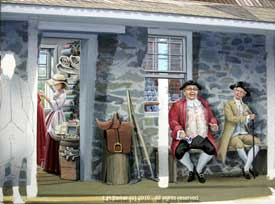 Periodic in progress updates are sent to the SHA team. Note the actual stonework and stones are reproduced in this painting |
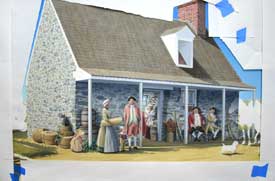 |
| Most of the surface is covered and protected while
I work on detail in areas. Because gouache is water based and matt, it
will pick up skin oils so I have to be very careful-most of the time I
wear a cotton paint glove with the fingers cuts off on my right (paint)
hand. |
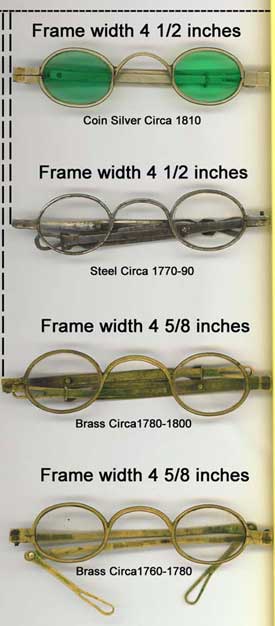 Only period correct glasses designs can be used on the characters. Couresy MD SHA. 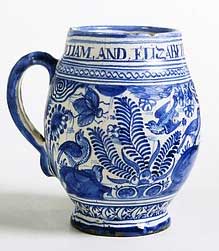 A tin glazed mug to be found inside the store. Courtesy MD SHA. 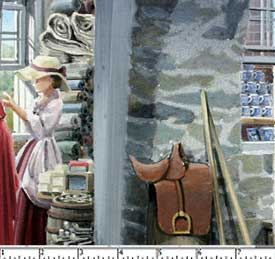 Close up of the teeny tiny detail of specific tin glazed mugs, clay pipes, bolts of fabric and olive soap bars waiting to be cut inside the store. Note the ruler for scale |
Stopping to update the client by shooting a digital picture, loading it onto the workstation, correcting the perspective and scaling it eats away precious painting time and takes several hours to do. The painting progresses with many snags from questions we forgot to ask such as: How does the coach stop/stay still? Is there a brake (answer was no, not this early a model)? When the driver hops off to deliver the sack of mail, should the horses be tied up to a post or would someone be holding the reins? Where would that person stand? What is the correct horse tack for this particular period and team of horses? |
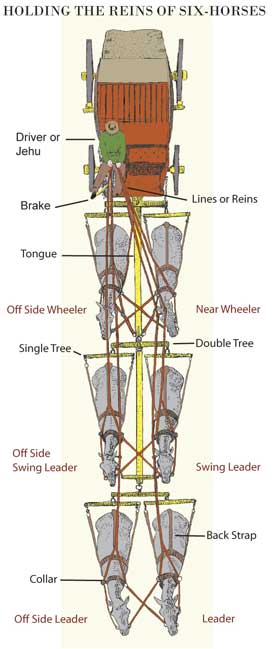 An aerial diagram of the correct tack and rein paths, Courtesy parks.ca.gov 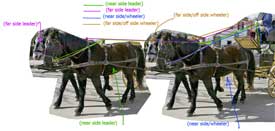 Above: color coding each rein to try and figure out how it is laced properly and where it goes next in a team of 4 horses. ****************************************************** |
| From a 1911 encylopedia on driving four-in-hand: |
| "The coachman should be careful to take the reins in his hand before mounting to the box-seat, as otherwise his team may make a start without his having the means to control them. It is customary to hitch the reins, ready for him to take them, on the outside terret (the ring on the pad through which the rein runs) of the wheeler - the off-side wheeler in four-in-hand. Standing on the ground beside the off-side wheel of his carriage, ready to mount to the box-seat, the coachman, after drawing up his reins till he almost feels the horses' mouths, must then let out about a foot of slack in his off-side reins, in order that when on his seat he may find all the reins as nearly as possible equal in length in his hand. He mounts with them disposed in his right hand precisely as they will be in his left when ready to start." |
At this late stage of the painting, we now know we will need to add a new man to hold the team of horses still, so it is back to the drawing board. Also, we realize that the hills west of the site will show up on the far side of the Anacostia River. We scramble to put together an idea of what would be open, wooded and the type of vegetation (this also gets addressed in much more detail in the Battle of Bladensburg painting). |
Team member Richard Ervin points out: |
| "The ball fields on the opposite bank of the river are an old landfill that has perhaps 30 feet of fill over the original swampland. The swamplands would have had a lot of tree cover on high spots in addition to areas of marsh grass in the low spots. Depending on how wet the swampland was during the dry season, it may have been tough to have timbered this area by 1814, so perhaps parts of this swamp would have supported more of a mature woodland. This area would have been right in front of the low hills that will be to the left of the MM house." |
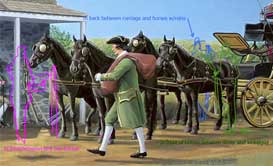 I give the client team the only 3 options I can think of without having to repaint an extensive area. The decision is to use a man in back of the horses (off side wheeler horse). 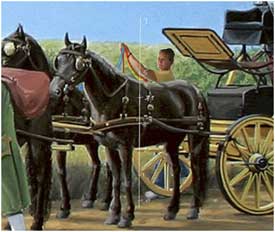 I have to stop painting and do mannequin work to get a figure who will show above the horses and still be identifiable as holding the reins. 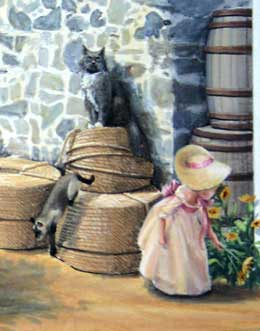 Final touches are added to the young girl, black-eyed Susans, barrels, road dirt colors and cats. 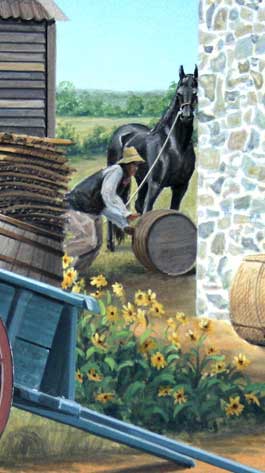 A Lowndes slave and black mare are finished. Those are the barrel staves piled high behind the cart with barrels. |
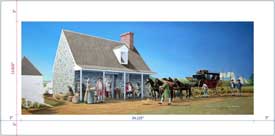 Time is running dangerously short to finish the piece . A guide for matting & framing with exact dimensions is sent now to the client. We run through any last minute paint revisions with the team and our scholastic experts. ****************************************************** |
| Orlando Ridout comments: |
| "I love these projects because they force us to think through all the little details and then chase answers--it is always a productive process." |
~September 30, 2010~ |
| The paining is finished and given client's final approval.
As with the Magruder House and the Battle of Bladensburg paintings, many
of my fine detail brushes get "toasted" from all the detail
painting. I set several aside to send my team as a mento of the hard work
accomplished during the overall project. I design the custom wood crates
to ship the artwork & they are fabricated.
The scanning firm is lined up. Paperwork like the reproduction rights (these are copyrighted paintings) is taken care of . The Magruder House and this painting are hand deliverd to Albany to be scanned, picked up, wrapped in a protective acetate film, bubble wrapped, crated and shipped out to Maryland. Multiple copies of the professional scans are burned for the client. The crate arrives in perfect condition and my client emails me to let me know they arrived safely and have been unpacked. "WHOA. Les, you are truly talented and gifted. We just received the paintings and opened them up. You are right, the computer images do not do them justice. The detail is absolutely amazing. Everyone saw them in our office and is blown away." They have the artwork professionally framed and ready for the private unveiling to a samll grouop of distinquished guests. I request feedback on all projects, as it helps me learn more about people's perception each time. Julie advises that the unveiling on November 3rd went very well: "Just got back from the reception and your paintings were very well received and everyone LOVED them. They appreciated we took the time to figure out the type of flowers in bloom in May and in August as well as the food on the dining room table. It was a big hit and I had all of these people wanting to post the paintings on websites and use them in publications not to mention museums." |
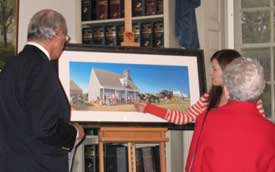 Above client Julie Scablitsky discusses the Market Master's house at the private unveiling. 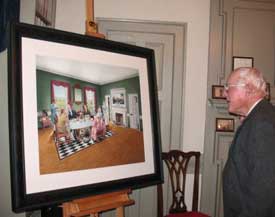 The Magruder House painting scene is studied. Courtesy Maryland State Highway Administration. |
| ~END~ |
| AN
ARTIST'S VIEWPOINT |
| The Magruder House, 1787 ("Politics and Port"): |
February 1, 2010 The design & composition begin. Magruder House is also known as the Old Stone House or the William Hilleary House. It is located along the Maryland State Highway right-of-way at Kenilworth Avenue, 47th Street, and along historic Annapolis Road (Maryland Route 450). This house is the only representation of an eighteenth century stone, gambrel-roofed house in Prince George's county. The building was listed in the National Register of Historic Places in 1978. Not only is this structure important for its architectural attributes, but also for its role during the War of 1812. The house was built out of sandstone by William Hilleary ca. 1742-1746. The 1798 Federal Direct tax list describes the house as one and a half stories high, 43 ft by 30 ft. The property once held outbuildings that included a log washhouse, a frame milk house, a stone meat house, a hen house and a framed stable with shed. In 1793, Hilleary sold the property to Richard Henderson, a prominent merchant, land speculator, and County Justice. George Washington noted his visit to the in his diary in 1787. Five years later in 1793, Henderson sold the property to his business partner, Dr. David Ross. Dr. Ross, a surgeon and merchant, was a founding inhabitant of Bladensburg. ****************************************************** Client's original description: |
| Setting: Richard Henderson's Dining Room at 2:30 pm, May 9, 1787
George Washington wrote in his diary that he rode
from Mt Vernon up to Bladensburg and dined at Richard Hendersons (Magruder
House). Washington then continued on to Laurel, Maryland where he lodged
at Snowdens and went to bed early with a headache and upset stomach. |
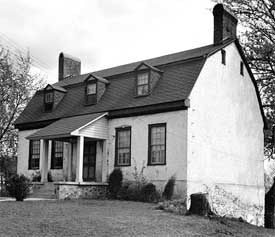 Exterior north elevation Magruder house, Historic American Buildings Survey John O. Brostrup, Photographer April 30, 1936, Courtesy Historic American Buildings Survey (Library of Congress), US National Register of Historic Places 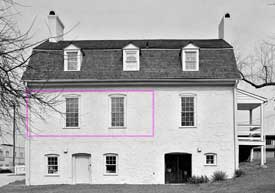 Exterior south elevation Magruder house, Historic American Buildings Survey John O. Brostrup, Photographer April 30, 1936, (I have highlighted the location of the dining room in this painting). Courtesy Historic American Buildings Survey (Library of Congress), US National Register of Historic Places 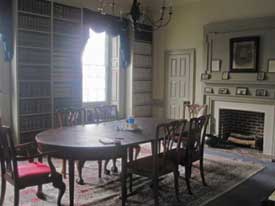 The restored dining room as it exists today. Courtesy MD State Highway Administration 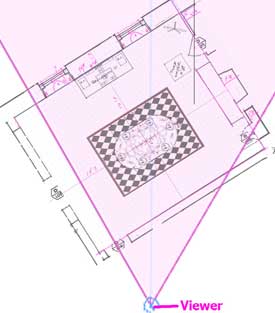 The room in plan and a 60 degree cone of vision suggesting one possible view 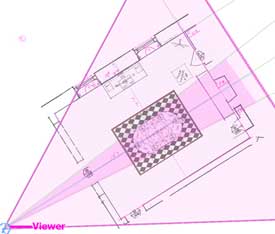 Above & below, other views being considered 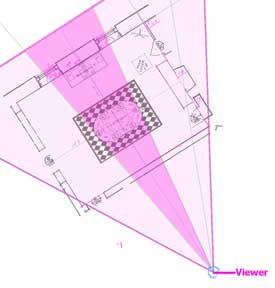 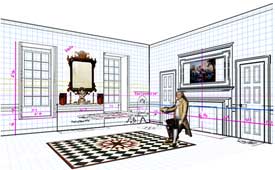 Using architectural elevations from the Historic registry submission and a similar view the client took to build a beginning 3-D room 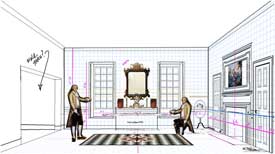 Studying another perspective view option which would have emphasized the symmetry of the room which was important for this period Working out where the characters will be & their possible interactions & the rough composition design impact 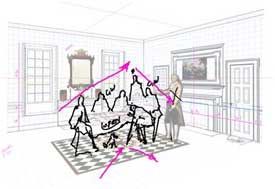 all seated except indentured servant 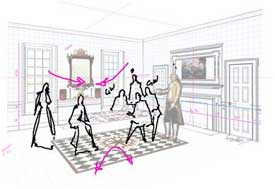 All seated but one woman and indentured servant 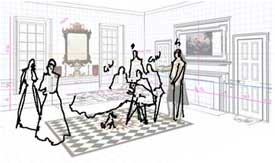 Men chatting after eating just finished; women leaving (nice flow to the whole room) |
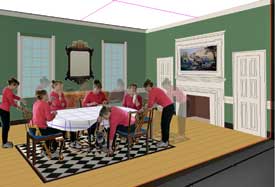 'Les' role playing, working out gestures and poses as I build on the rough perspective selected from the above line perspective. There was not enough time to collect a number of people to help with poses, so I would put my camera on timer and run to the other side of the room, shoot a frame and repeat until I got enough variation to work with. 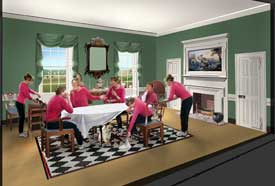 Adding more detail to the rough composition-period drapes, fireplace building materials. Below: even the table dinnerware and who sat where followed proper period etiquette 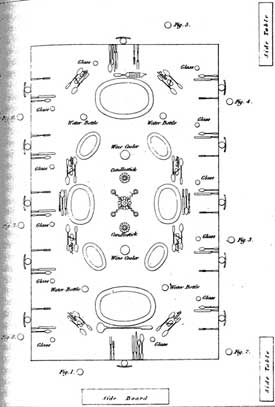 Diagram of table service from Thomas Cosnett's "The Footman's Directory and Butler's Remembrancer (5th ed., 1825). Courtesy Henry Francis du Pont Winterthur Museum Library; Collection of Printed Books) 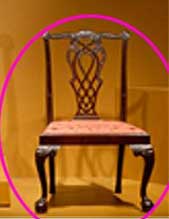 Discussing which Chippendale design would be the most accurate & authentic 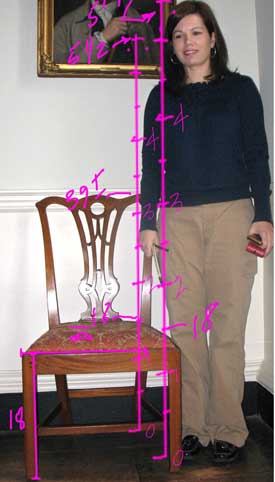 Julie Schablitsky stands next to a dining chair for scale from rare collection of Chippendale dining chairs made regionally from the Hammond Harwood House collection. This design will be the final chair used in this scene. I extrapolate the dimensions from Julie's height. 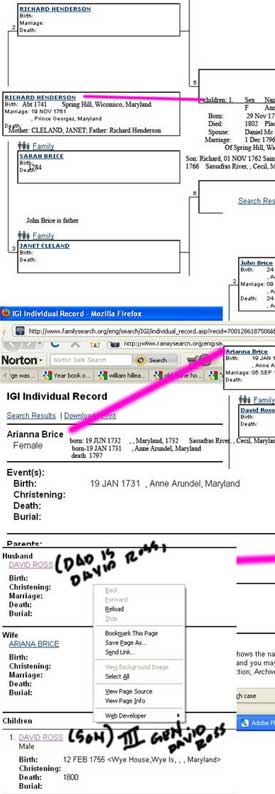 Searching for the exact ages of the characters and any physical characteristics recorded: here on the website familysearch.org which had an amazing amount of material going back hundreds of years. 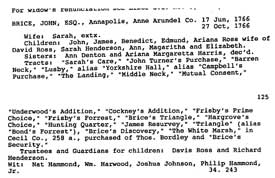 Sarah Brice as John Brice ESQ estate executrix upon John's death in 1776  Portion of the Dr David Ross Death Inventory, 1777-1780 |
Things get complicated when research turns up a number of "David Rosses" around this time. Client sends a "stop the press" email while this is figured out. It turns out that the David Ross that was supposed to be in our composition had passed away roughly at the time this painting is set. His 32 year old son, David Ross Jr, will replace him in the same chair. Very complicated family connections, but as it was explained to me by my client: Dr. David Ross: Born in 1728. Married Arianna Brice in 1750. Had a son, David Ross Jr. in 1755. Becomes business partners with Richard Henderson. Lives in Ross House that sat on Ross Road. Served as George Washington's Personal Physician in Revolutionary War (1775-1783). Died in 1778. Dr. David Ross' Son is Major David Ross, Jr. Esquire: Born in 1755. George Washington put him in charge of Continental Army (1775-1777). Ross resigned his post in 1777 to study law. Admitted to the Bar in 1783 and began practice in Frederick County. Between 1787-1789 he served as Delegate to Continental Congress from MD. In 1789, George Washington appointed Ross as auditor. In 1793, David Ross Jr. purchased the Magruder House and the accompanying land from Richard Henderson. So, what this means is that Richard Henderson and Dr. David Ross Sr.were business partners. Richard and Dr. David married Sarah and Arianna Brice, who were sisters. David and Arianna had a son, David Ross Jr. David Ross Jr. was then son to Dr. David Ross and nephew to Richard Henderson. ******************************************************** Question comes up what we would see out the windows back then. I get on Google Earth to see what would be included looking out the dining room windows (in the current 2010 USGS view). The center bottom yellow tack is the actual location of this structure today; it is surrounded by highways on all sides. |
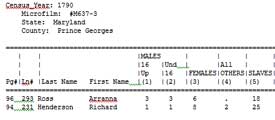 What should we show for 1787? Would Richard Henderson's slaves be working out in a field? They are documented in this 1790 census 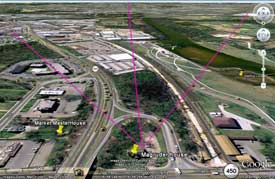 What would the far distant background look like (it cannot be seen today with the highways, buildings and trees). 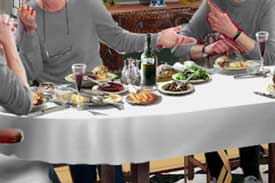 Things continue to progress on the rough composition as what specific foods, wines, dishes can be found on the table, what is the proper order of silverware, plates, utensils and the like. Everything has to be authentic for this period, even down to the floral table arrangement. 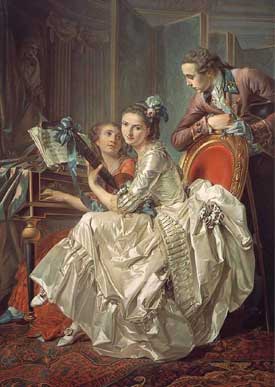 "The Music Party" by Rolland Trinquesse, 1774 is used as a guide for Richard Henderson's daughter's dress.. Courtesy Alte Pinakothek, Munich Below: we have decided to open the closet door to expose what was originally a dumb waiter, now a closet for educational purposes. 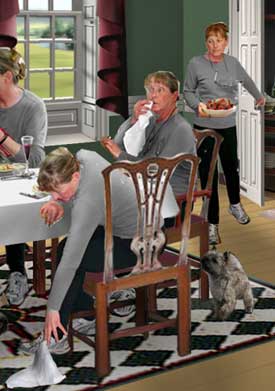 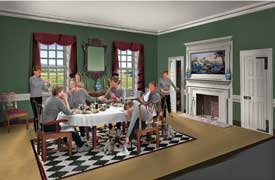 Rollover the above 2 images to see how the mannequins slowly get replaced
with period dress and final faces. The room also continues development.
Richard Henderson's daughter's (bending over) was inspired from the 18th
century painting above. Period artwork gives us a wealth of knowledge
about culture of a specific time, as do written accounts like diaries,
journals & newspapers. Rollover the above 2 images to see how the mannequins slowly get replaced
with period dress and final faces. The room also continues development.
Richard Henderson's daughter's (bending over) was inspired from the 18th
century painting above. Period artwork gives us a wealth of knowledge
about culture of a specific time, as do written accounts like diaries,
journals & newspapers. |
| The extra chair against the wall
to the left will become a vehicle to discuss George Washington's diary
entry of his stay: "Crossed from Mt. Vernon to Mr. Digges a little after sunrise and pursuing the rout by the way of Baltimore-dined at Mr. Richd. Hendersons in Bladensbg. and lodged at Muir. Snowdens where feeling very severely a violent hd. Ach & sick stomach I went to bed early." Below the actual page, but with my highlighting. |
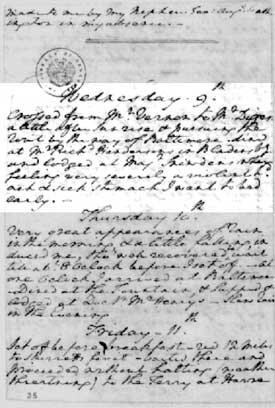 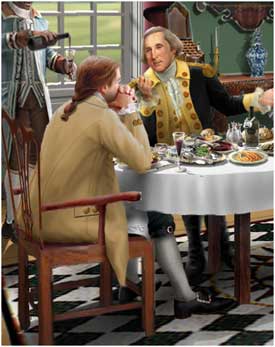 Working on George Washington & Richard Henderson's outfits |
It is later decided Washington should not have the contrasting gold on his jacket at this point (that is more presidential). This particular outfit was based on an exhibit at the Morgan Library & Museum. Also found at the Morgan were images of Washington's life mask cast (below) 1785, within a few years (he was 53 years old) of when our scene took place. The decision was made to alter Washington's face to be closer to the actual plaster cast of his face, rather than the well known portraits. |
 Washington life mask images courtesy of the Morgan Library and Museum. |
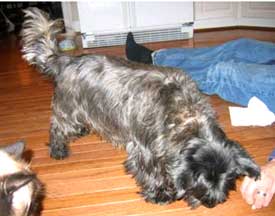 Team member Julie's Scottish Terrier, Ozzy, gets in the act with some dog mannequin work & role playing to help get just the right dog position. Courtesy Julie Schablitsky. Below-Ozzy, detail in the finished painting 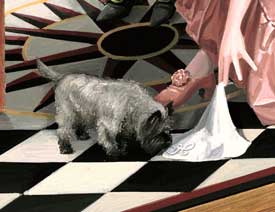 |
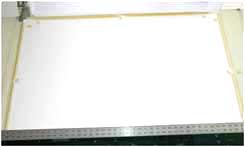 The illustration board is taped securely to the work table on all four sides 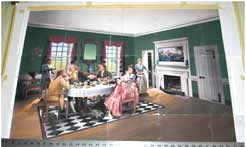 The rough composition or painting "road map" is registered to the illustration board and taped at the top. 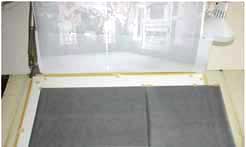 Graphite or transfer paper is laid over the illustration board with the graphite surface facing down 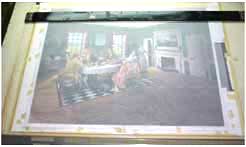 A sheet of tracing paper is laid over the print out and a line version is traced onto the tracing paper. This will serve not only to transfer the image to the illustration board but as an ongoing guide during the painting process. The colored rough comp is then removed and taped to a nearby wall for reference. ************************************************** At that point, someone on the SHA team catches that the young woman bending over could not psychically accomplish this because of the binding upper body rigid stays (corsets) using whalebone inserts worn in this time. 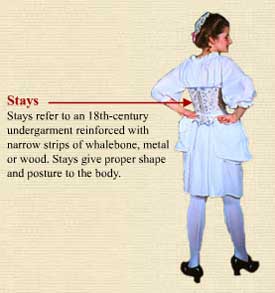 Back profile of a Colonial woman's stay (corset)
with whalebone, metal or wood inserts. Courtesy history.org Back profile of a Colonial woman's stay (corset)
with whalebone, metal or wood inserts. Courtesy history.org |
More Les-mannequin work demonstrates it is still possible to bend even if the back is straightened out. So the character stays in, but must be reworked to twist from the hips & shoulders rather than waist and mid back and still have the straight back. The dress must also be redone to reflect this shift. Roll over the image below to see the original pose morph to the new pose with a straightened back, twisting from the hip and shoulders rather than the waist and mid back. |
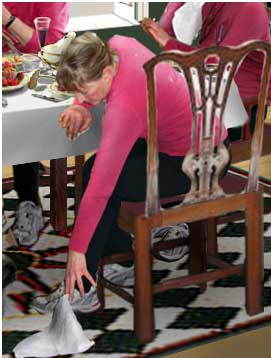 **************************************** |
| Back to the transfer/paint stage! |
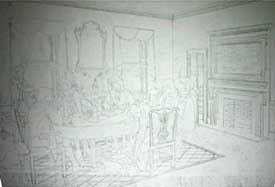 View of the faint graphite line transfer on the illustration board 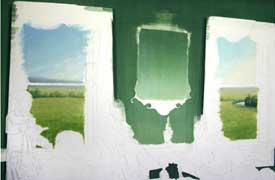 Walls and outside the windows is painted. Since the walls are plaster, a light brush texture is left. Our Google Earth check (above) indicates that we will just barely catch the Anacostia River at the far right in the view during this time period. 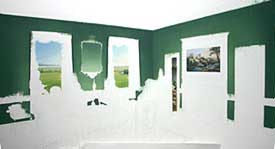 More of the walls, closet and fireplace painting 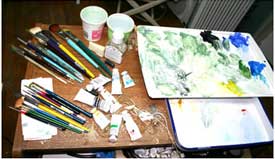 Paint palettes, brushes, tubes of gouache on my taboret while working 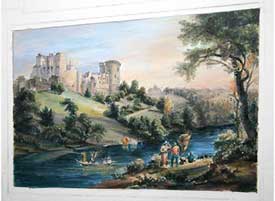 Close up of the mantel Scottish period gouache painting selected for this piece, in perspective-also painted in gouache in this painting. I tried to clean up some of the aging of the actual piece, as it would have only been 26 years old at the time of our scene. The real 1761 Paul Sandby gouache painting. "Bothwell Castle on the Clyde" is below. Courtesy nationalgalleries.org. 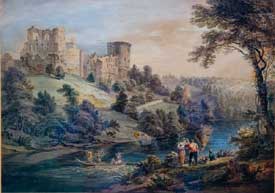  Detail of the closet/dumb waiter showing the Creamware plates and dumb waiter construction. You can see the light graphite transfer lines left and right of the painted area. 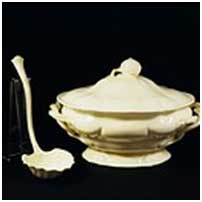 Soup tureen used on the painted dumb waiter above 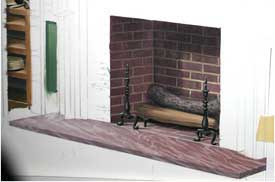 Fireplace gets painted. It is later decided by the client that the logs must come out to reflect this time of year, so the firebox has to be repainted. 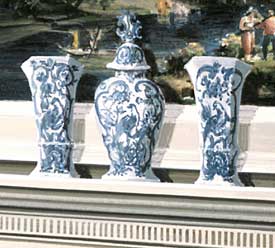 Detail of the hand painted three piece blue and white garniture mantel set. Below, the actual delft vase & urn set. 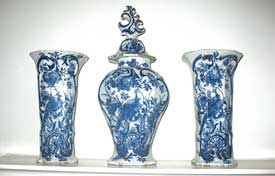 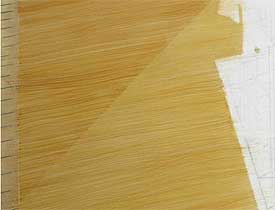 Laying in the pine floor boards and the shadows that fall on them takes many translucent layers of paint to get the grain just right. On the left you can see the floor board widths struck as they come forward in space. While I am painting, more detail revisions are requested on the rough composition, so it is back and forth between the rough and painting the finished artwork. 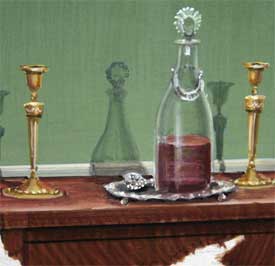 Detail of the sideboard, wine decanter & brass candlesticks 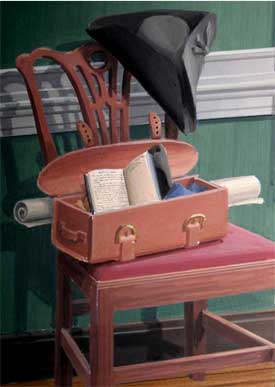 detail side chair, Washington's hat, and travel gear 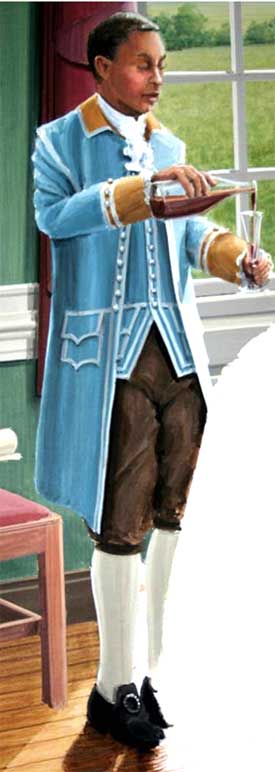 Richard Henderson's slave gets finished 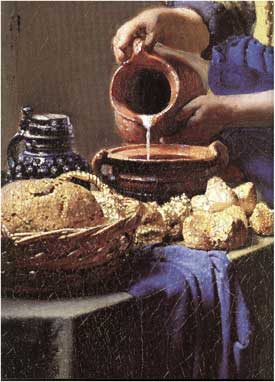 Time to decide exactly what type bread/rolls/basket might be period authentic & we turn to this 1658 Johannes Vermeer painting, The Milkmaid, for inspiration and information, Courtesy Rijksmuseum, Amsterdam. 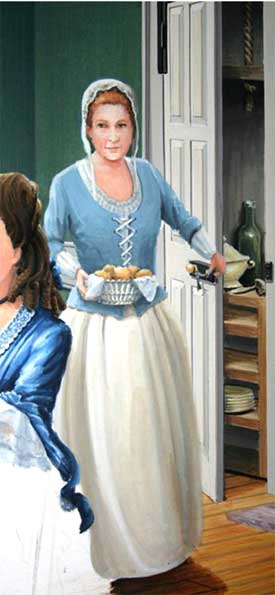 As does his indentured servant from Scotland 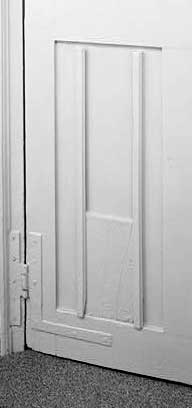 A portion of Historic American Buildings Survey John O. Brostrup, Photographer April 30, 1936 showing the original hinges still on the closet door. Courtesy Historic American Buildings Survey (Library of Congress), US National Register of Historic Places 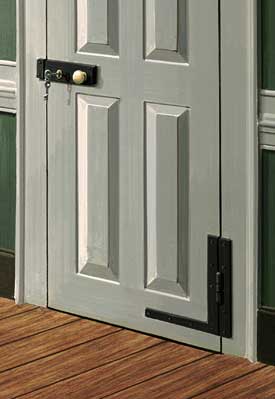 The hardware was faithfully reproduced in the finished artwork. 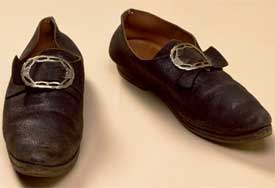 Picking out the perfect period shoe buckles for the host, Richard Henderson. Courtesy history.org 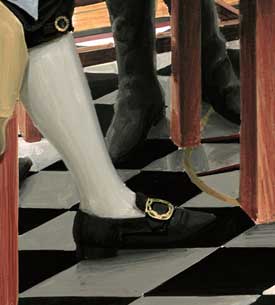 Henderson's shoes and stockings in the finished artwork. 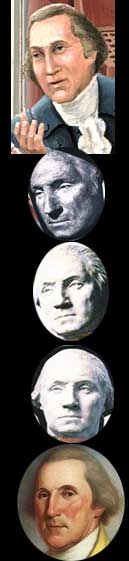 The faces of George Washington: top to bottom-my final composite/ Magruder painting, 1785 life mask/Morgan Museum, Jean-Antoine Houdon bust done from life mask/courtesy Mount Vernon, (mirror image for comparison) from James Peale 1787 portrait/courtesy Independence National Historical Park Collection. All done at roughly the same age. 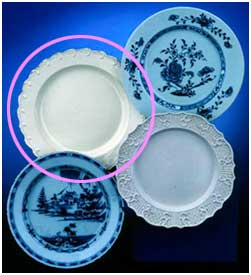 Above-fragments of period creamware like the circled plate above were found in the archaeological digs at the site. Below-detail of the creamware (fragments found on the site) holding beets, olives, carrots & fresh spinach-all of which would have been present in this location this time of year, the floral creamware centerpiece using local flowers: poppies, bluebells of Scotland & peonies 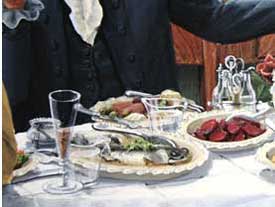 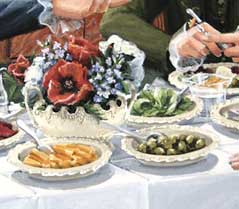 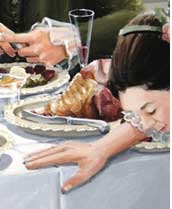 |
~May 30, 2010~ The painting and piece are finished. Shipping will wait until the Market Master's House is finished. Both paintings will be presented November 3rd, 2010 (see the bottom of the Market Master's House column). |
| ~END~ |
AN
ARCHAEOLOGIST'S VIEWPOINT |
| Project Team Leader Julie M. Schablitsky, Chief Archaeologist, Maryland State Highway Administration |
| Additional team members: Richard G. Ervin, senior archaeologist, MD State Highway Administration Nichole E. Sorensen-Mutchie, lab director, MD State Highway Administration; Archaeologist, MD Environmental Service Susan Langley, State Underwater Arch- aeologist, MD Historical Trust ************************************************** |
| Many thanks to the consulting experts who provided the team with valuable input and feedback: |
The Market Master's House ("Open for Business"): -Orlando Ridout V, Chief, Office of Research, Survey & Registration, Maryland Historic Trust -Kevin Crisman, Director, Center for Maritime Archaeology and Conservation, Texas A & M University -Nancy A. Pope, Historian and Curator of Postal History, National Postal Museum, Smithsonian Institution The Magruder House ("Politics and Port"): -Carter Lively, Executive Director, Hammond Harwood House The War of 1812/Battle of Bladensburg |
This project encompassed much more than just the period artwork. Below, I share with you some of the images from the archaeological digs at these sites and the educational outreach. All images below, courtesy Maryland State Highway Administration. More in depth information can be found at the Bladensburg blog link at the bottom of this column. |
Project Backgrounds in chronological order |
The Market Master's House, 1777 ("Open for Business"): |
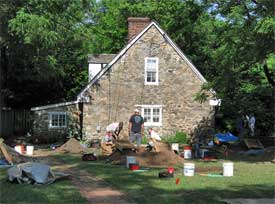 East face of the Market Master's house. 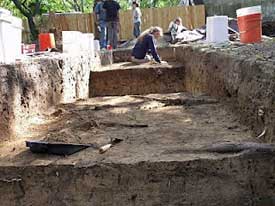 "It is really interesting to see which units are yielding the colonial artifacts and which are showing a strong prehistoric presence. Most of the colonial artifacts seem to be concentrated in units closest to and directly behind Market Master’s house. We have yet to find a privy, though, and it’s still a mystery to where that might be." 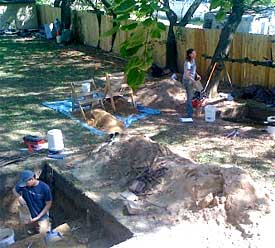 "Only two more days left to dig in the Market Master’s backyard. As expected, we may have the ephemeral remains of an outbuilding. In several of our units, we discovered dozens of badly decomposed nails and fasteners associated with the colonial stratum. Although it is a bit too early to make conclusions about our findings, it appears that when Christopher Lowndes built his stone house in 1760 he eventually added an outbuilding behind the house. The building does not appear to be residential since there are so few personal items." 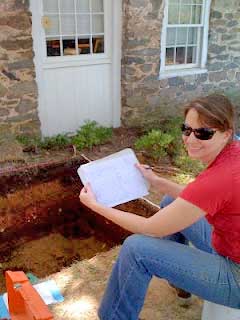 "Archaeological activities are beginning to wind down at the Market Master's house. We spent a fairly mild summer day recording unit profiles and finishing excavations of the last few units." |
The Magruder House, 1787 ("Politics and Port") |
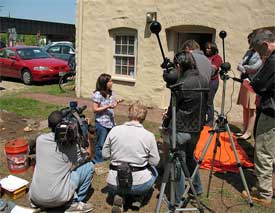 Lights, camera & action in front of the existing Magruder House 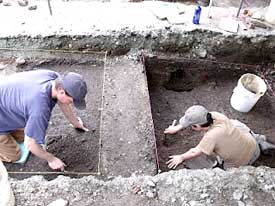 "Today (Tuesday March 25th) we continued excavations in the new units we started yesterday while Rick and Tom continued work on unit 1. Units 3, 4, and 5 were still inundated with water so we called in the big guns! The state highway’s administration brought us an industrial-sized water pump to allow us to transform units 3, 4, and 5 from bathtubs to workable, albeit very muddy, archaeological units." 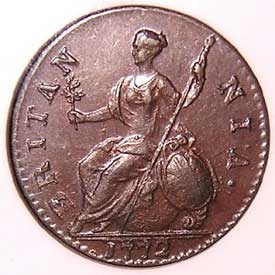 "While excavating at the house, SHA archaeologists recovered a British 1774 King George halfpenny like the one pictured. For the public and the press, the coin was a palpable connection to the period of time just before the American Revolution and the subsequent tension that led up to the forgotten and fascinating event that made the town famous again, the Battle of Bladensburg. We cannot be certain where the coin came from, whether it was dropped by a wounded British soldier or was simply amongst the pocket change of Mr. Henderson, the occupant of the house at the time." 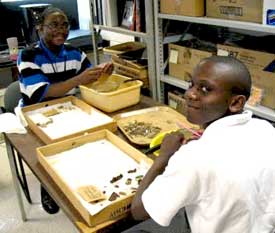 "Today Tara and I had some special helpers at the Maryland State Highway Administration archaeology lab. Marcell Thompson (left) and Javon Epps (right), Towson High School seniors, are participating in the Summer Youth Employment Program. They are interning with the Project Planning Division and get to experience different careers within SHA. They helped us wash artifacts from the Magruder House." |
The War of 1812/Battle of Bladensburg, 1814 ("The Parole of An American Hero"): |
| Excavation of the Indian Queen Tavern site turned our sights to the actual Battle of Bladensburg field, see that column on the right. |
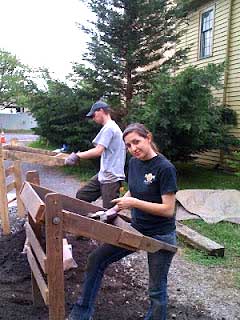 "Each test unit excavated today represented a different use of the site, from the earliest to the latest historic occupation. The only major concern is that we may have only scratched the surface of the Indian Queen Tavern period – where are all the pipestems and liquor bottles? With any luck, we’ll start turning them up in the next day or so!" 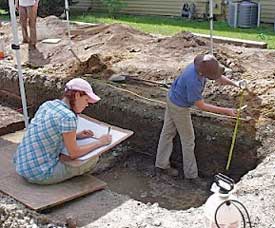 "Another activity that took place today included recording the stratigraphy of the site. The archeologists record the different layers of soil they see in the walls of the pit they have dug and this can help them determine the time period and activities of that layer." 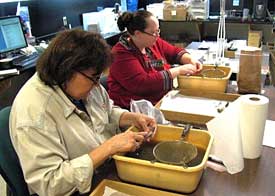 "In this full-speed-ahead, high-tech age of cyber-this and virtual-that, it’s reassuring to know that some things still require the human touch; that tools can be as simple as a Dr. Du-More’s toothbrush, a common kitchen sieve, a plastic pan of water, and a pair of willing hands. And even though yesterday’s four-hour stint left me with blanched hands and puckered fingers better suited to the corpse of someone tragically lost at sea, I’m ready to head back to the lab and give it another go next week." |
Miscellaneous & community outreach shots |
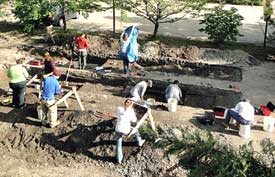 "The Cultural Resources Section at the Maryland State Highway Administration (SHA) produces a quarterly newsletter. The summer edition of the Cultural Resources Bulletin (CRaB) is a special extended issue. It includes in-depth articles on the Bladensburg Archaeology Project, as well as information on other SHA projects." 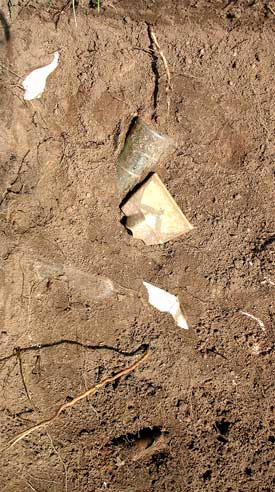 Artifacts being revealed in the layers of soil 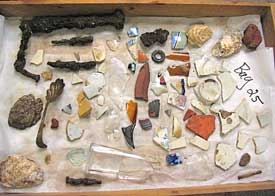 "Favorite finds? A serving spoon with shell-shaped bowl and rather elegantly bent handle; part of a plate from the Municipal Hospital (a psychiatric facility, I’m told); a small piece of scalloped, blue-edged ceramic; a few animal bones (Ah! Mortality); and an oddly shaped piece of corroded metal I still say looks like a miniature fertility goddess—I dub thee “Bladensburg Venus." 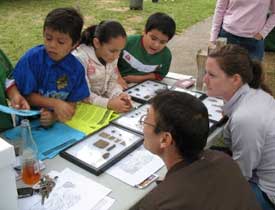 "A display of artifacts from the Magruder and Market Master’s House excavations were presented. At the Port Town’s day celebration children were given the opportunity to take part in a mock dig. Here are some photos from the events." |
About the Team |
| Julie M. Schablitsky directs the Cultural Re-sources Section at the Maryland State Highway Administration and serves as their Chief Archaeologist. Her recent research includes the War of 1812, 18th and 19th century domestic sites in Maryland, and John Paul Jones' Birthplace in Scotland. She also serves as a lead archaeologist on the PBS Series, Time Team America. |
Project Funding |
| The Bladensburg project was funded through the Transportation Enhancement Program and the Maryland State Highway Administration. |
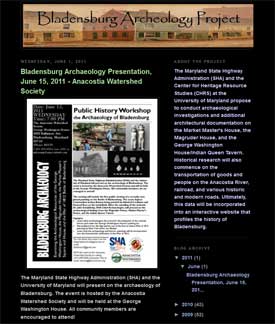 Visit http://bladenarch.blogspot.com/ Click here to open in a new window to read weekly accounts & comments of the archaeological events while in progress! 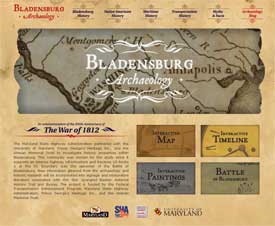 Visit http://www.bladensburgarchaeology.com/ Click here to open in a new window to see the Bladensburg archaeology interactive site. |
| ~END~ |
| AN
ARTIST'S VIEWPOINT |
| The War of 1812/Battle of Bladensburg "Embrace of the Enemies", 1814 ("The Parole of An American Hero"): |
October 20, 2010 The design & composition begin. Initially, this illustration began as a War of 1812 streetscape on Bladensburg's main thoroughfare or what is now Route 450/Annapolis Rd. With a gunshot wound to the thigh, Commodore Joshua Barney was to be seen carried on a stretcher down the main street in Bladensburg by British Capt. Wainwright and 3 other British sailors towards the field hospital (Ross Tavern) and passing in front of the George Washington House on August 24, 1814 @ 6 PM The client requested we explore the humanity, mutual respect and compassion between enemies noted in various written accounts rather than focus on battle carnage. The view and location of the piece were eventually moved west to near the Maryland/Washington border at the conclusion of the Battle of Bladensburg (adjacent to what is now the Fort Lincoln Cemetery) due to lack of supporting and necessary archaeological evidence after the team's archaeological digs. |
November 1, 2010 The scene and story shift to the battlefield: |
| ***************************************************** For an short description of the Battle of Bladensburg/War of 1812
check www.bladensburgarchaeology.com or www.wikipedia.org/wiki/Battle_of_Bladensburg ***************************************************** Setting: August
24, 1814, 3:45 PM, Bladensburg Rd to Washington at the county line. Barney was mounted between the two 18 pounders in the middle of the road when his horse was shot from under him. He then stood next to the canon when he was shot in the upper right thigh. The ball went in at an angle from his upper right thigh and into his hip area. He lost a lot of blood. Three of his men tried to help him leave the battlefield, but they only walked a few paces before Barney sunk down to the ground. Two of the three men left and attempted to escape. Lt. Jesse Huffington stayed behind with Barney to await capture by the British. Lt. Scott came upon Barney and supported him. He left Barney briefly and brought back Ross and Cockburn. "Well admiral, you have got hold of me at last," said the commodore. "Do not let us speak on that subject, commodore", Cockburn replied. I regret to see you in this state. I hope you are not seriously hurt." "Quite enough to prevent my giving you any trouble for some time," said Barney. Ross heavily praised Barney for his fighting. Ross and Cockburn spoke amongst themselves at which time they sent for their surgeon. After dressing Barney's wound, Cockburn paroled Barney allowing him to go to DC or Bladensburg. Wainwright was also there and was commanded to carry Barney down to Ross' tavern in Bladensburg. |
Client defines final key characters, their interaction & begins to put together the resources/research we will use. |
1. Captain Wainwright (first captain to Cockburn, British Royal Navy): (No known photo). He is dressed in a short round jacket, very young looking. In the scene, he will be looking down at Barney. |
2. Admiral George Cockburn (British Royal Navy): His body language communicates a bit of arrogance, but his face shows concern …. compassion does play on his lips as he tells Barney that he hopes he is not seriously hurt. |
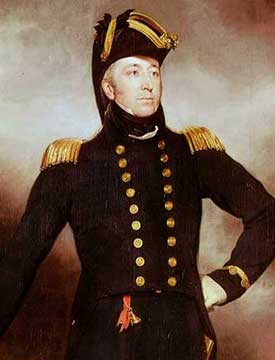 (Cropped) John James Halls portrait Rear-Admiral Sir George Cockburn, 1772-1853, (1776-1834) c. 1817. Courtesy National Maritime Museum, Greenwich, London. One of several portraits done in his life & used to study Cockburn's facial characteristics |
3. Lieutenant Colonel William Scott, British Royal Navy: (No known portrait) He is looking down at Barney's wound. |
4. General Robert Ross, British Royal Navy: On bended knee, he holds a canteen of water in his hand as if he has just offered Barney a drink (this is later changed) and he is looking at Barney's face |
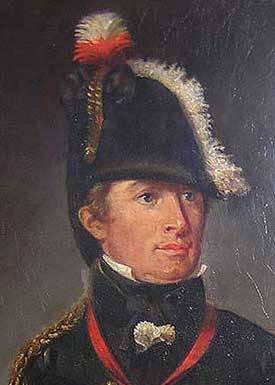 (Cropped) General Robert Ross portrait, Unknown artist. One of several portraits done in his life & used to study Ross' facial characteristics |
5. Commodore Joshua Barney (American US Navy): He will be pale from loss of blood and diaphoretic. His expression of one of discomfort, but not wincing pain and he is listening to Ross. He is 55 years of age. |
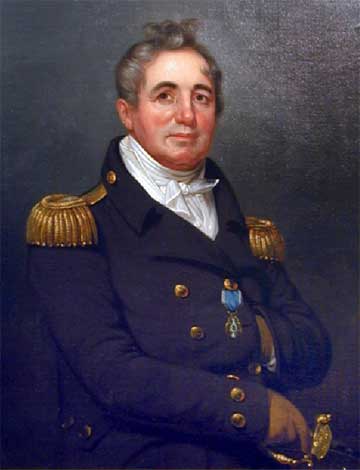 1819 Rembrandt Peale portrait of Joshua Barney commissioned by the city of Baltimore; one of several portraits done in his life used to study Barney's facial characteristics |
6. Lieutenant Jesse Huffington (Barney's aide & Sailing Master, US Chesapeake Flotilla): (No known portrait). He was 22 years of age. Body language and facial expression is that of protection and respect of his fallen commodore. Jesse is looking up and listening to Ross. ****************************************************** |
| Lining up & analyzing 300 years of historical maps in the Bladensburg area for the project's second Battle of Bladensburg view study: The topography of the area changed dramatically over the course of 300 years. Many geographical landmarks no longer exist to enable easy registering of maps. |
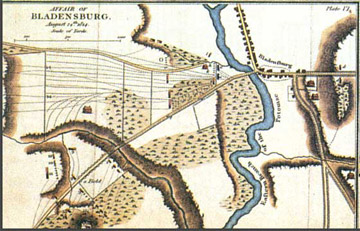 Affair of Bladensburg, 1816 Map inset, Memoirs of My Own Times by General James Wilkinson shows the troop movement 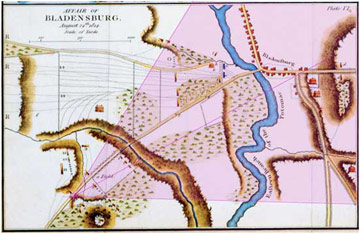 A 60-degree 'cone of vision' in pink over the Wilkinson Map studies a possible view looking NE down the hill towards the town of Bladensburg. 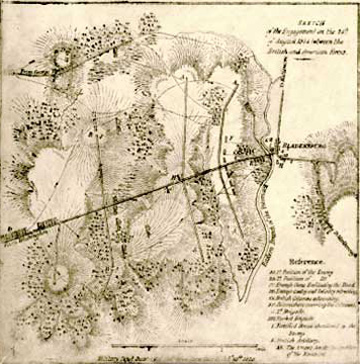 Roughly the same area as the Wilkinson map, above is a portion of an 1814 sketch by D. Evans, L't 3d Dr'ns D'y As't Q'r Mas'r Gen'l."Sketch of the march of the British Army under Gen'l Ross from the 19th to the 29th August 1814 : [central Maryland between Benedict and Washington D.C.]. Courtesy Library of Congress. The team is looking at different maps to splice together a composite of the action location & the topography in 1814. 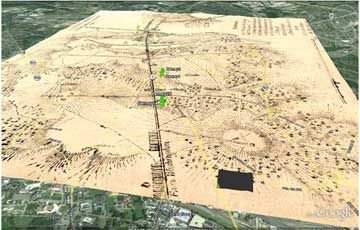 The 1814 D. Evans map superimposed in perspective on current terrain in Google Earth, looking NE 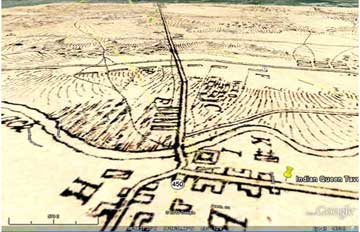 The 1814 D. Evans map superimposed in perspective on current terrain in Google Earth, looking NE up the hill towards Washington DC 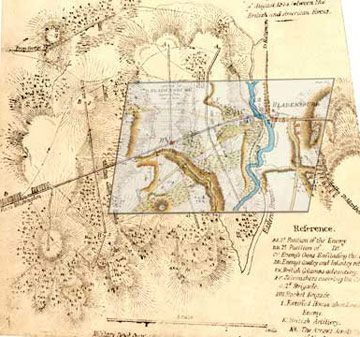 Trying to line up different maps with different scales: 1816 Wilkinson Map Insert over 1814 D Evans Map 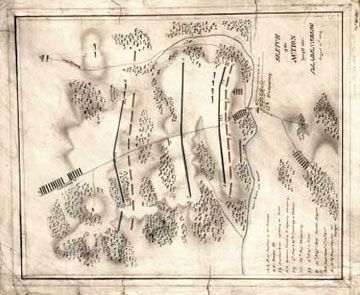 Another map of the troop locations, Battle of Bladensburg: sketch of the action fought near Bladensberg [i.e. Bladensburg], August 24th, 1814/Thos. Ormsby, Weedon, July 19th 1816, Courtesy Library of Congress 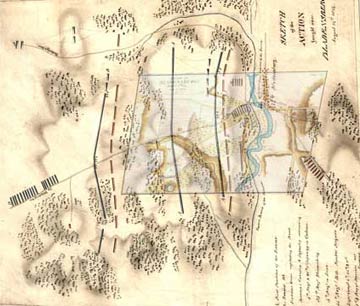 Continuing to line up different maps/different information: 1816 Wilkinson Map Insert over 1816 Ormsby Map 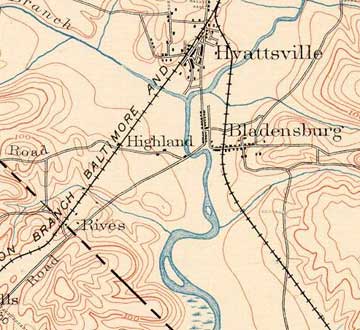 Section, 1886 USGS map; the Rives property mentioned in battle accounts still exists & is noted on this map 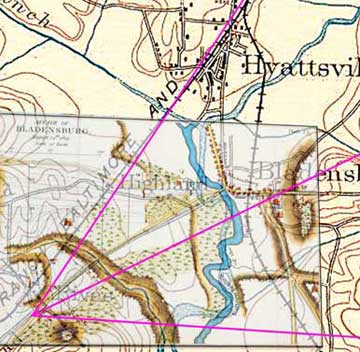 Wilkinson Map over 1886 USGS map with potential view (pink lines) 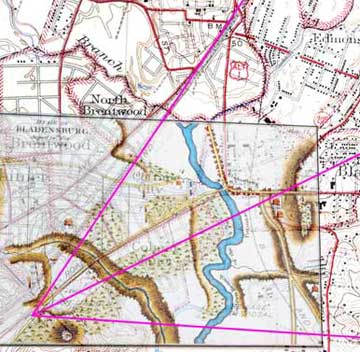 Wilkinson Map over 1946 USGS map with potential view 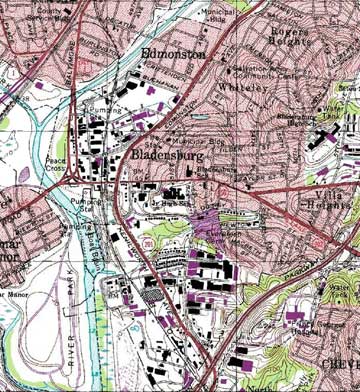 1979 USGS map in the vicinity of Bladensburg 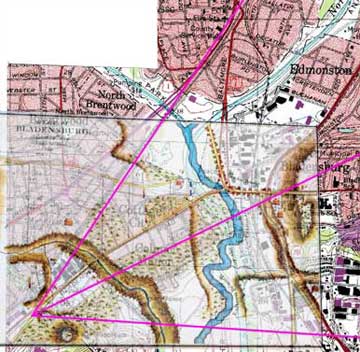 Wilkinson Map over 1979 USGS map with potential view 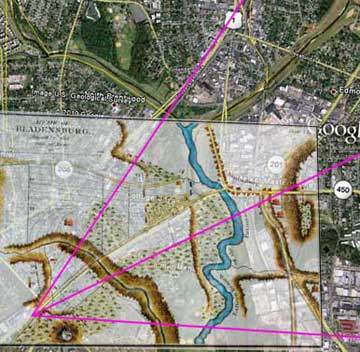 Wilkinson Map over 2010 USGS map with potential view in Google Earth ******************************************************** |
| Building the rough composition & study |
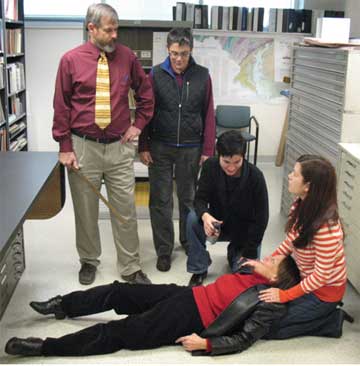 MD SHA team role-playing & doing mannequin work for main characters poses. Left to right back row: Richard Ervin, as George Cockburn; April Fehr, as William Scott; Lisa Kraus, as Robert Ross. Front: Anne Bruder as Joshua Barney and Julie Schablitsky (team leader), as Jesse Huffington. Nichole Sorensen-Mutchie, photographer. Courtesy MD SHA. |
Rough composition begins to be built digitally on my workstation. |
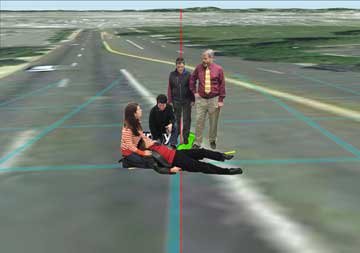 A mirror image of the SHA team's character positions super imposed on a real time Google Earth perspective view with a 10' grid overlaid. Looking down the hill NE towards the town of Bladensburg 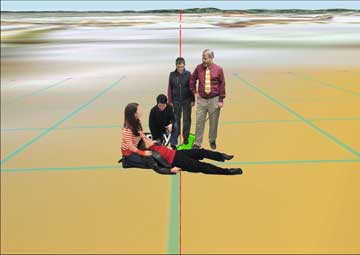 A mirror image of the SHA team's character positions super imposed on a 3-D version of the 1816 Wilkinson Map & a 10' grid for scale (overlaid in Google Earth) looking down the hill NE towards the town of Bladensburg 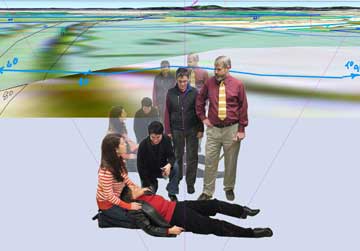 Google Earth perspective with many period topo corrections & the 1816 Wilkinson map 3-D overlay. Character positions (mirror image) super imposed (2 scale choices). 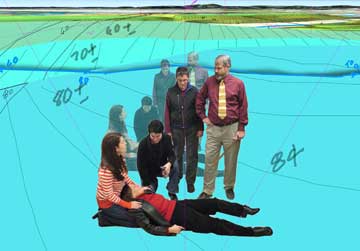 Modeling the new (1814) topo elevation zones to show the (Dueling) creek, Anacostia River & town of Bladensburg beyond. 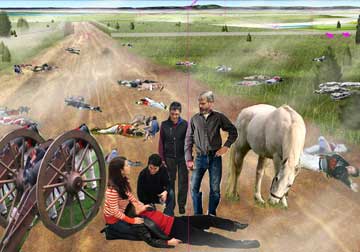 Dropping in additional props, figures (without regard to dress) & vegetation material in the rough composition 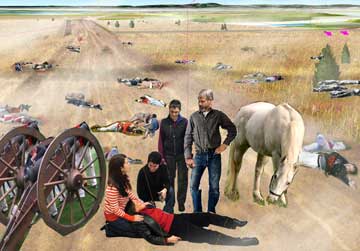 Changing the vegetation to reflect the dryness and extreme heat of August 24, 1814. There are written accounts of men collapsing & dying in the heat that day; it was reported it was in the low 90's that morning. 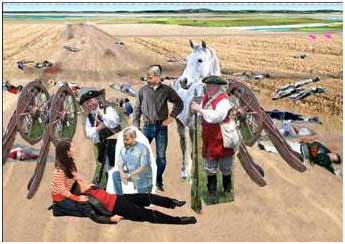 Experimenting with main character placement, gestures, props & proximity to the 18# cannons 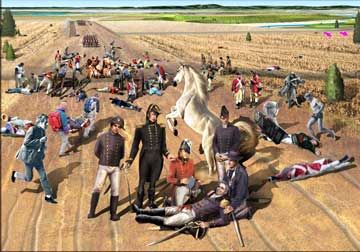 Working on peripheral figure placement & movement without regard to mannequin attire. The main characters get flipped back to their original positions. |
This rough composition development continued up until January 13, 2011, when the client made the decision to change the view & direction swinging roughly 100 degrees clockwise (looking SE) to the view above. ****************************************************** The rough process begins all over again with core characters thus far & Google Earth perspective shots of existing topography to establish the new direction & cone of vision (below). |
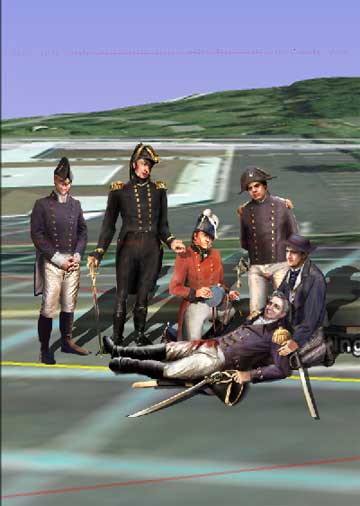 New view/direction, same physical location: this vertical format is changed to the horizontal one below 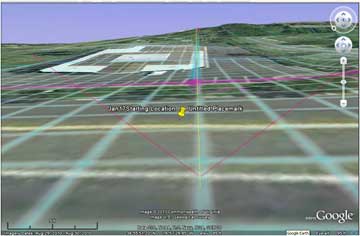 Developing this new view progresses 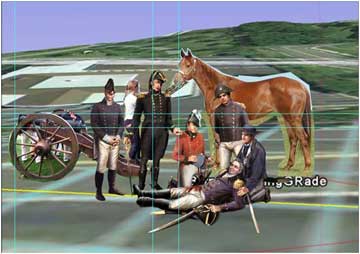 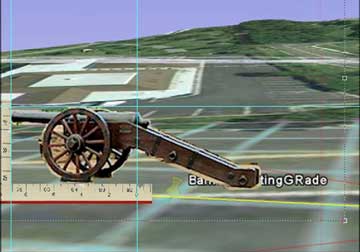 Always checking for correct scale: the foreground 18 pounder cannon 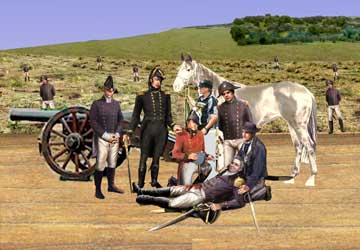 Adding textures for the 1814 landscape; adjusting contemporary topo contours to reflect 1814 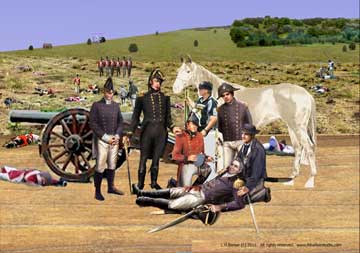 Placing British & American troop figures/killed, injured and alive for scale and location without regard to their dress 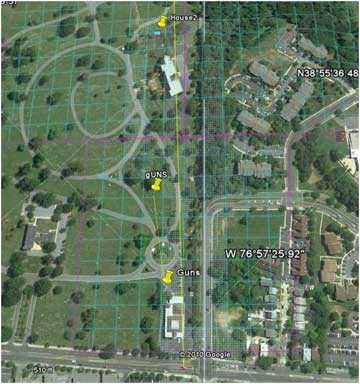 Locating exactly where Veitch's House/Hill and the 12# cannon line would fall today; Google Earth aerial with 100' grid overlay 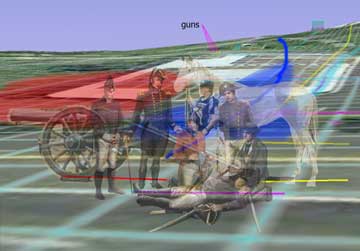 Establishing the American and British lines and their paths at the end of the Battle of Bladensburg (red-British; blue-American) 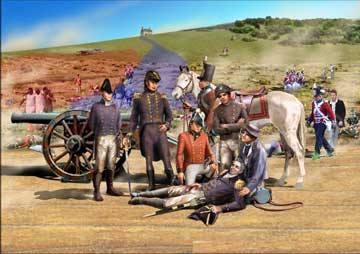 Tweaking those boundaries with client as more characters & props get developed; there is constant daily back and forth communication between team members 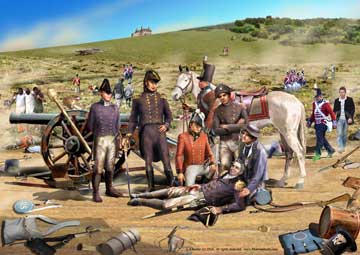 Working out rough ideas for the foreground and "road litter". 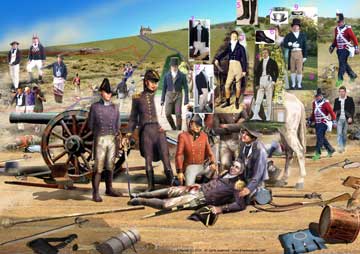 Discussing very specific clothing details back and forth 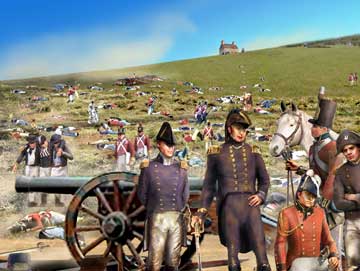 Adding soldiers to the mid and distant grounds, deciding who should be an American or British & doing an actual head count of the number of British & Americans on the hill. 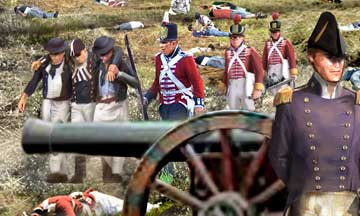 Details, details, details: adding a British guard behind wounded Americans 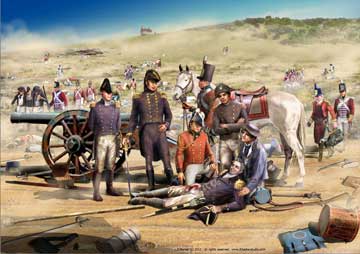 Working out the smoke/dust effects we want. Decision was made to leave it translucent rather than the heavy, opaque smoke & dust one normally sees in battle paintings, in order to show more battle aftermath detail |
| ~March 4, 2011~ The final Battle of Bladensburg rough composition is finally done. It has been almost 5 months of non-stop work & research for this piece to get to this point. Hand painting the gouache interpretive historical War of 1812 illustration begins! ************************************************** |
| The rough composition is printed out in pieces &
spliced to full size, 24"h x 34"w. A line drawing is transferred
via graphite paper as a painting guide and the painting process proceeds.
For a more complete methodology of this process, please see "An Artist's
Viewpoint", Magruder house on this page for rough composition transfer
details. The full size rough is hung on a nearby wall to act as a road
guide to the painting. The subject matter calls for a more brisk, raw
& active painting style than the Magruder and Market Master's house
paintings. |
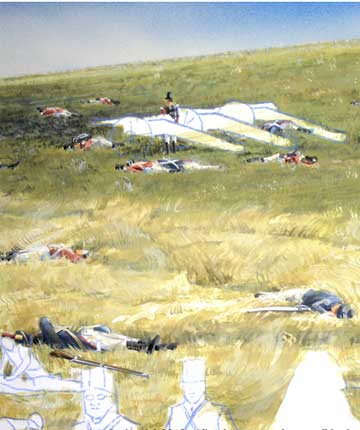 The sky and grounds & tree line are painted in first. Here 3 twelve # cannons in distant ground, scorched fields & pasture from the battle, fallen British & Americans-all in tiny accurate battle dress 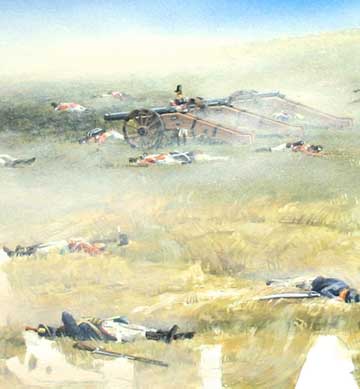 Same area but with the 12# cannons done & the residual smoke & dust from the battle added. The painting starts to become moody and atmospheric. As I work on each soldier, I wonder what they had been thinking when struck down, who their families were, what they felt about this war and who they left behind. It leaves me very emotionally drained at the end of each day. 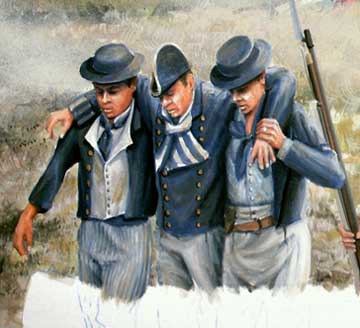 Detail of wounded Americans being escorted off the battle field. Showing the toil and emotions of each man, as well as the uniform details, takes time and care even for secondary figures. 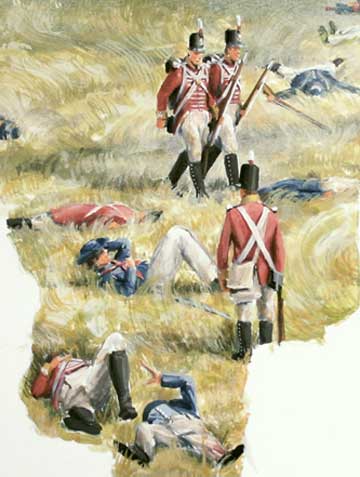 Soldier detail before final smoke & dust are painted in 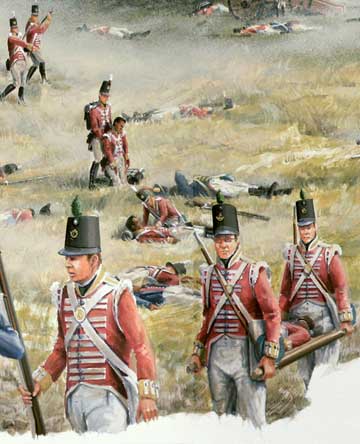 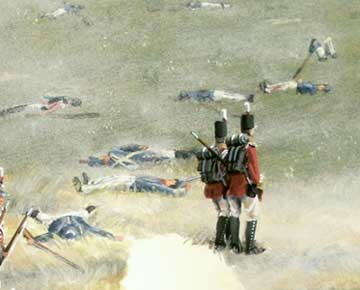 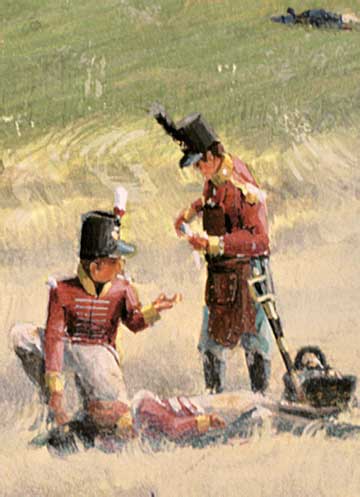 Close up of one of the field surgeons attending the wounded, final detail 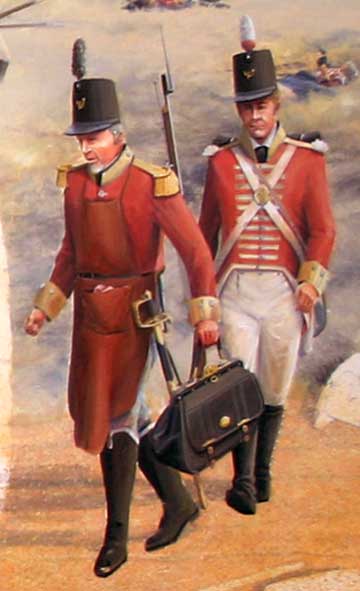 Detail of the surgeon wearing a bloodied leather surgeon's apron rushing to assist Joshua Barney before final layers of smoke & dust are painted in 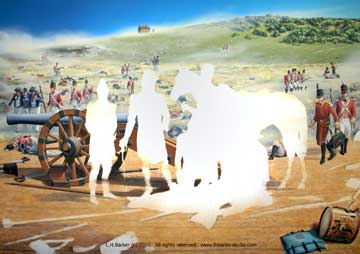 Most of the secondary material is finished & work turns to the key characters and foreground. The 18# foreground cannon will eventually have its wheel design changed. 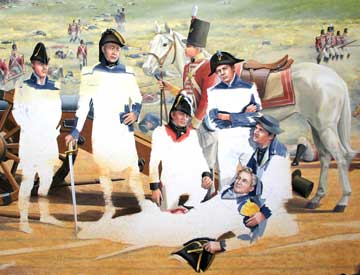 Painting begins on the main characters faces and hands after the horse and soldier behind them are finished. Every square inch of the painting gets checked for period authenticy, down to the horse's blanket & tack, saddle and hats strewn about the ground. 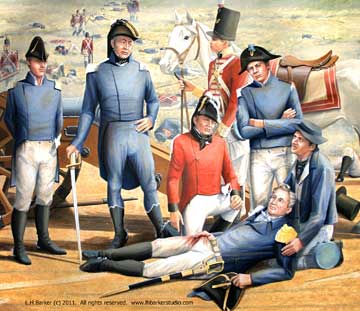 Uniforms start to take shape and details of the main characters 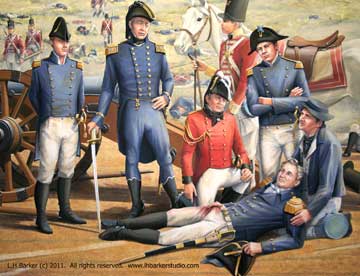 A lot more detail is added including suggesting tiny correct buttons/buttonholes, shako plates for each soldier and Joshua Barney's belt buckle. All the men's uniforms are dusty, dirty, sweaty and show wear. 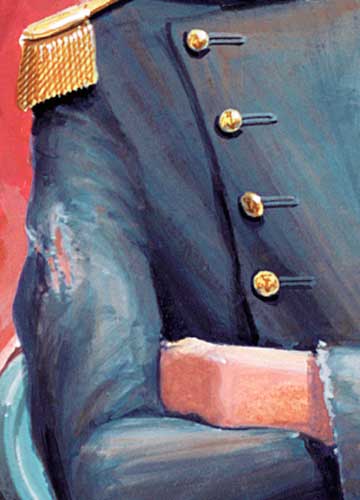 Detail, Scott's torn and frayed uniform 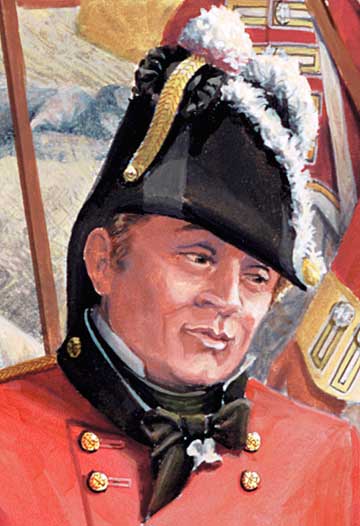 Finished British General Robert Ross 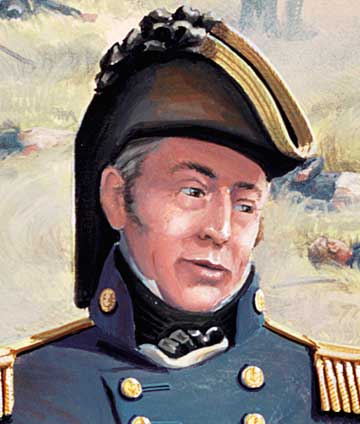 Detail: Finished British Admiral George Cockburn 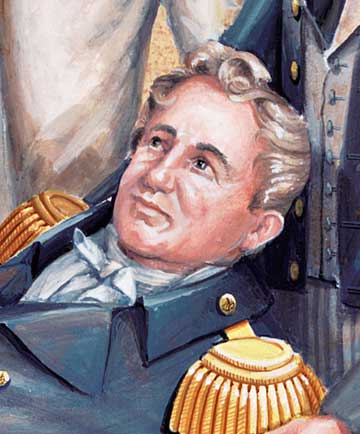 Detail: Finished American Commodore Joshua Barney 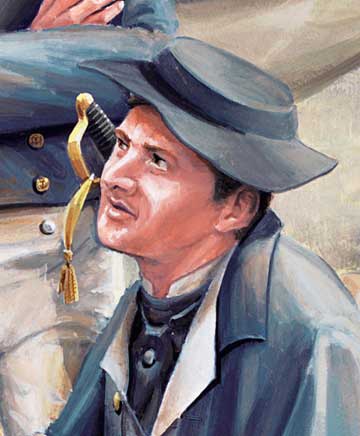 Detail: Finished American Sailing Master, Lieutenant Jesse Huffington, as we might imagine him (no known portrait) 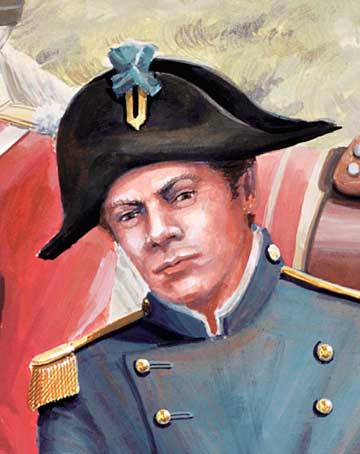 Detail: Finished British Captain Wainwright (first captain to Cockburn, British Royal Navy), as we might imagine him (no known portrait) 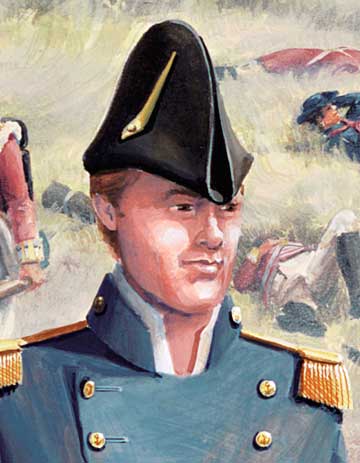 Detail: Finished Lieutenant Colonel William Scott, British Royal Navy, as we might imagine him (no known portrait)  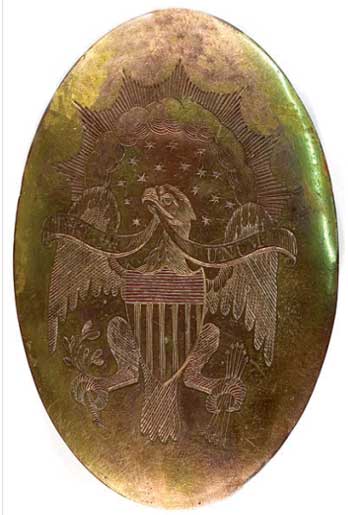 A surviving antique American shoulder medallion (held crossed straps in place at chest center) is used as a guide for the lost medallion left in the road sand in the foreground. There were hundreds of items researched during the project that were used as guides for authenticity. 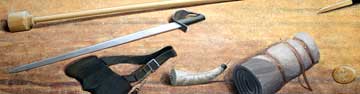 The foreground cast aside or lost soldier items are finished 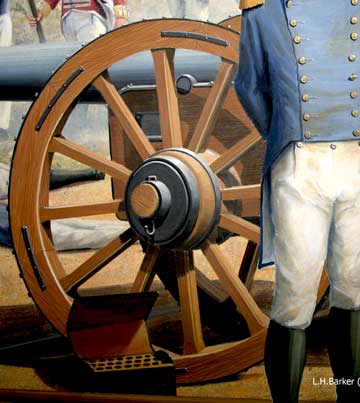 It is decided that the foreground 18# cannon wheel construction is too archaic for 1814, so the wheel has to be repainted with new strapping hardware & wood joints. 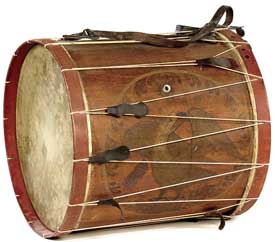 An antique militia bass battle drum that was used in the Battle of Bladensburg painting. Top: the actual drum (courtesy cowanauctions.com) , bottom: the painted drum without the 200 years of age, fading & wear. 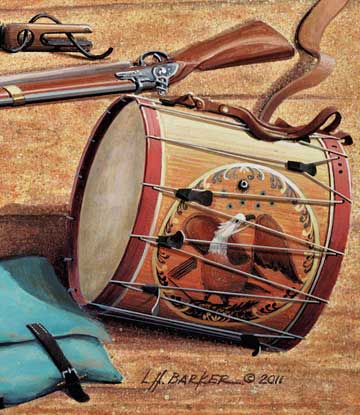 Signing, copyrighting and dating the painting. From the first Indian Queen Tavern concept to finished Battle of Bladensburg painting took the team 7 1/2 months to complete. 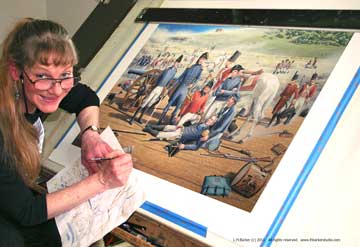 |
| A bit weary & wide-eyed after a marathon 17 months
of extremely long & intense work days working on the suite of 3 paintings,
a few quick promo shots are taken for my client. After the professional
scan & shipping are taken care of, the suite of the 3 Bladensburg
interpretive historical paintings project is done and under the care of
the Maryland State Highway Administration, Cultural Resources department. When the crate is opened and the painting inspected first hand, my client advises: |
| "Just unpacked it and we are all speechless....it is a beautiful piece..." |
| and the report from the unveiling/reception: |
| "It was a smashing hit. ...About 70 people there....standing room only. I gave the presentation on the archaeology of Bladensburg and then read a few paragraphs from Anthony Pitch's book that set the scene for the painting with the painting next to me covered. The tension was mounting and then the painting revealed. There was a pause and the room burst in applause. The audience, including Barney's descendents, all wanted prints from it. Rick gave background on the players and painting and people loved it. Looks like it was a home run Les. You out did yourself. " |
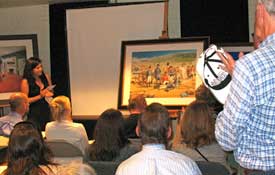 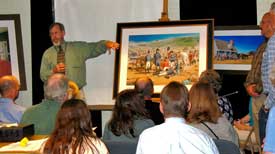  June 15, 2011: team members Julie Schablitsky (top image, standing left in the lovely black dress), Richard Ervin (middle and bottom in the olive shirt and Nichole Sorensen-Mutchie (the photographer and out of the images) host the unveiling of "Embrace of the Enemies" and field questions about the project and their research. Courtesy Maryland State Highway Administration. -copy-3.jpg) |
| Special thanks to Lisa Zeimer, AICP, Assistant Vice President, Parsons Brinckerhoff, Environment Manager and Henry Ward, Parsons Brinckerhoff for their help managing the contract paperwork while I tried to focus on the artwork. |
| ****************************************************** |
| Please stop by again & visit my other fascinating
suites of historical paintings: Historical projects index and Overall portfolio index Thank you for your interest! Les Barker/L.H.Barker |
| ~END~ |

|
    |
 |
| 331
Ridge Rd, Queensbury, NY 12804 Phone: (518) 792-0879 Website (c) L.H.Barker 2004-2015. All rights reserved. |
Interpretive architectural and historical
|
 |
  |
 |
 |
  |
  |
 |
|
 |
|
 |
|
 |
|
 |
| Architectural Illustration ; www.lhbarkerstudio.com Related search terms: Bladensburg Archaeological Project, Magruder house, Market Master's House, War of 1812, Indian Queen Tavern, Port Of Bladensburg, Julie Schablitsky, Maryland State Highway Administration, Battle of Bladensburg, archaeological paintings, antiquity illustrations, technical imagery, hand painted architectural illustrations, architectural perspective, rendering, perspectivist, historical visualization, Bladensburg historical district |
| Website (c) L.H.Barker 2004-2015. All rights reserved. |


